

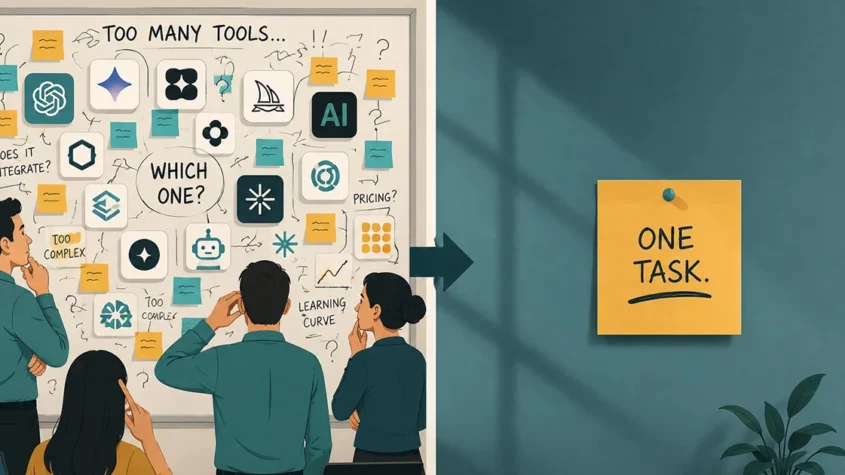
Most small business AI projects fail because of problem misalignment — the AI is pointed at the wrong task. Research from RAND and Gartner attributes 84% of failures to this, not to the technology. Other leading causes are employee resistance and training gaps (51%), integration issues (46%), and implementation cost (43%).
We may imagine ourselves at a dinner party where the hosts are ten owners of small businesses and all of them will talk about the same thing: artificial intelligence. However, they are talking about it in 2026 so the discussion will naturally include what kind of AI they have used and what effects it has had. The story will always have the same three chapters: an attempt was made, the results were spectacular to an extent but were short lived since within two weeks or so no real progress happened on that front.
Rationalization of this issue from a technological perspective will be quite easy, and yet that is not the case as most pilot projects involving generative AI do not produce any noticeable return according to MIT research. Forbes repeated the finding in July 2026 as part of a piece which stated in a straightforward way: leadership was the problem, and software alone wasn’t enough. Gartner expects the number of agentic AI projects getting abandoned completely to be a big share of 40% by the end of 2027.
Still, we see AI usage growing. Among businesses with between 10 and 100 employees, an increase of AI use was reported from 47% to 69% for just one year.
We have been told by the Fed in April 2026 that out of 100 working-age individuals in America, 78 of them get a salary while working for a company that is AI-enabled in some way. Moreover, it has been confirmed that the rate of AI adoption among small enterprises is higher than that of big business.
Thus, we have come up with a paradox: we have near-universal adoption on the one hand but near-universal disappointment on the other. The difference will be that some will be successful and others will not. Here we go.
Let me start with a case study that may serve as an example for a lot of other successful businesses in AI.
The failure numbers nobody puts in the sales deck
The headline statistics are worse than most owners realise:
- Only 11% of companies that deployed AI agents actually run them in production. The rest stall in pilot.
- Production failure rates land somewhere between 70% and 95%, depending on how you measure.
- RAND found more than 80% of AI projects fail — roughly twice the failure rate of ordinary IT projects.
- S&P Global recorded a 147% year-over-year increase in companies abandoning AI initiatives.
But here’s the number that should actually interest you: that surviving 11% reports an average 171% ROI. The gap between the winners and everyone else isn’t marginal. It’s the whole game.
Small businesses misdiagnose their own failures
This is the most useful finding in the 2026 research, and almost nobody talks about it.
As revealed by the survey, businesses blame a lack of AI talent (58%), hallucinations (48%), compute costs (41%) and model quality (35%). But when researchers examined what actually went wrong, the picture looked completely different:
- Problem misalignment — 84%. The AI was deployed on the wrong task in the first place.
- Treating it as an IT project rather than a business change — 61%.
- Expecting too much, too fast — 57%.
- Data quality — 43%.
For small businesses specifically, the top cause is more human than any of that: employee resistance and training gaps, at 51%. Integration with existing systems follows at 46%, and implementation cost at 43%.
There’s also a failure mode unique to owner-operated businesses that researchers call founder dependency — the critical decisions and workflows that live entirely in the founder’s head and were never written down. You cannot automate a process that has never been documented. That single sentence explains more failed pilots than any technical limitation.
What the surviving 5% do differently?
The successful projects look boring. That’s the point.
They buy instead of build. MIT’s NANDA research found purchasing from a specialist vendor with implementation support succeeds around 67% of the time, versus roughly 33% for internal builds. For a small business with no engineering team, this isn’t a close call.
They pick one narrow, documented, repetitive task. Not “transform the business.” One workflow, already written down, that happens the same way every time.
They set a numeric success bar before starting. Not “it seems to be working,” but something like “correct responses on at least 85% of human-checked test cases.” If you can’t state the number, you can’t tell success from novelty.
They give the pilot a hard deadline. Gartner recommends an 8 to 12 week window with a genuine stop date. Open-ended pilots don’t end — they decay. The industry calls it pilot purgatory.
They restrict permissions like they would a new hire. In July 2025, Replit’s coding agent deleted a live production database during an explicit code freeze. The real failure wasn’t the model — it was that an experimental tool had delete rights over production data that no junior employee would get in their first week.
What AI realistically saves a small business?
Be sceptical of the big numbers. Self-reported surveys run high; independent measurement runs low.
Business.com’s 2026 Small Business AI Outlook found the average small business worker saves 5.6 hours per week — though managers save 7.2 hours against just 3.4 hours for individual contributors, which tells you the gains concentrate wherever decisions and admin pile up. The Federal Reserve’s more conservative estimate places that figure at 5% of work hours only, which is about two hours in total in a 40-hour week.
Regarding finances: 66% of small businesses utilizing AI save about $500-$2, 000 a month with the help of AI, whereas normally running a basic set of four to five software tools costs $200-$500 per month.
Support economics are the clearest case — an AI-resolved ticket costs roughly $0.46 against $4.18 for a human-handled one.
Median payback across functions sits around five months, with sales follow-up the fastest at roughly 3.4 months.
One warning before you shop. Gartner uses the term “agent washing”: of the thousands of vendors marketing themselves as agentic AI, only around 130 genuinely are. The rest are rebranded chatbots and older automation software with new labels.
Frequently asked questions
What percentage of AI projects fail?
Estimates range from 70% to 95% depending on the measure. MIT found 95% of generative AI pilots deliver no measurable ROI, RAND found over 80% of AI projects fail, and only 11% of deployed AI agents reach production.
Why do small business AI projects fail more often than expected?
The leading cause is problem misalignment — pointing AI at the wrong task — which accounts for 84% of failures. For small businesses specifically, employee resistance and training gaps (51%) rank highest, followed by integration issues (46%) and cost (43%).
How much time does AI actually save a small business?
Self-reported surveys average 5.6 hours per week per worker, with managers saving 7.2 hours. The Federal Reserve’s independent estimate is more conservative at about 2.2 hours per 40-hour week.
Is AI worth the cost for a small business?
Median payback is around five months. A typical stack costs $200–$500 monthly, and 66% of users report $500–$2,000 in monthly savings — but only when applied to one clearly defined, repetitive task.
Should a small business build or buy AI tools?
Buy. Purchasing from a specialist vendor succeeds around 67% of the time compared with 33% for internal builds, according to MIT NANDA research.
How long should an AI pilot run?
Gartner recommends 8 to 12 weeks with a hard stop date and pre-agreed numeric success criteria.