

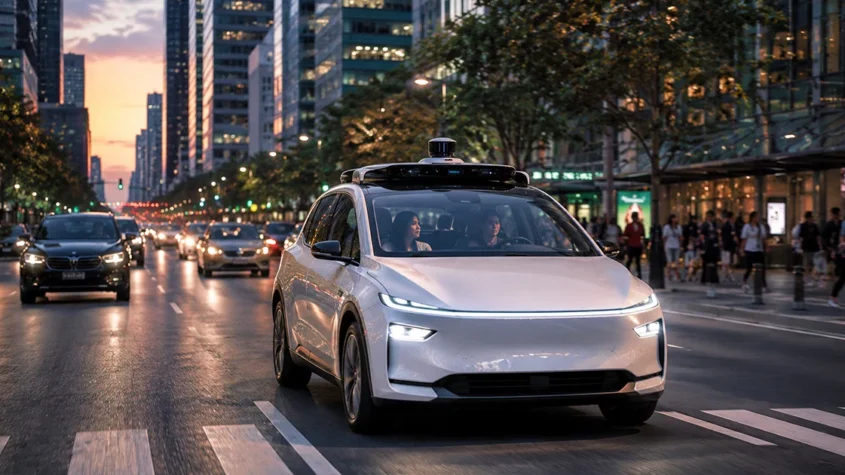
For years, self-driving cars seemed to belong to the future.
Sure, the technology keeps getting better, the demo videos look incredible, and billions are pouring into autonomous driving. But it has just a little changed for ordinary people. A driverless taxi remained something to watch in a demonstration rather than something to book for a normal trip.
That started changing rapidly.
2026 has become a major turning point for the robotaxi industry. Driverless taxis are no longer limited to small technology demonstrations. Waymo alongside Baidu’s Apollo have already launched paid driverless ride services that target regular commuters. In parallel, competitors such as Tesla and Pony.ai who are in the same category as Waymo, and Chinese companies WeRide as well, are actively expanding their fleets of autonomous vehicles.
In March 2026, it was revealed that Waymo alone was able to handle roughly half a million robotaxi rides per day, paid ones at that, all across the US. Its fleet has remained around 3,000 vehicles, showing how dramatically vehicle utilization has improved as commercial demand has grown. The bigger story, however, is not simply the number of rides. It is the transition from robotaxis as an experiment to robotaxis as a business.
What Changed for Robotaxis in 2026?
The self-driving industry did not suddenly invent a completely new technology in 2026. Sensors, cameras, LiDAR, artificial intelligence, mapping systems and autonomous-driving software had been developing for years.
What changed was the ability to combine those technologies into a commercially viable service.
A robotaxi needs much more than a vehicle capable of driving itself. Companies also need fleet management, remote assistance, charging infrastructure, insurance, regulatory approval, maintenance operations and enough paying customers to make the economics work.
That is where 2026 looks different.
Waymo’s weekly paid rides increased from approximately 50,000 in May 2024 to 500,000 by March 2026—a tenfold increase in less than two years.
That kind of growth is difficult to describe as a simple technology demonstration.
It is a transportation business beginning to operate at scale.
The Numbers Behind the Robotaxi Boom
Waymo is currently one of the clearest examples of the shift toward commercial autonomous transportation.
The company operates roughly 3,000 robotaxis and reported 500,000 paid rides per week across 10 U.S. cities in March 2026. Its rider-only driving volume was around 4 million miles per week.
The growth becomes even more impressive when compared with previous years.
In 2024, Waymo was still completing tens of thousands of paid trips per week only. By 2025, that figure had surpassed hundreds of thousands of trips. Then a milestone was achieved in March 2026, it had doubled to over half a million rides per week.
China is developing its own large-scale robotaxi ecosystem.
Baidu’s Apollo Go reported 3.2 million fully driverless operational rides during Q1 2026, with weekly rides exceeding 350,000 in March. By April, the service had surpassed 22 million cumulative public rides, while its global footprint reached 27 cities by May.
These numbers show why 2026 is being treated as an important year for autonomous mobility.
Robotaxis are no longer being evaluated only by how well the software performs.
The industry is increasingly being measured by rides, revenue, fleet utilization and geographical expansion.
Robotaxi Companies Are Going Global
Another important change is geographical expansion.
The next phase of the robotaxi industry is not simply about adding another neighborhood in an existing city. Companies are increasingly looking outside their original markets.
Waymo raised $16 billion in February 2026 at a $126 billion post-money valuation, with the company saying the capital would support expansion into additional cities and international markets. London and Tokyo were among the international markets associated with its expansion plans.
Chinese autonomous-driving companies are following a similar strategy.
Apollo Go has been expanding outside China, including operations in Dubai and planned testing in European markets. Baidu said in May 2026 that Apollo Go’s global footprint had reached 27 cities.
Pony.ai is also targeting international growth. In August 2026, the company announced plans involving more than 4,000 robotaxis for overseas deployment, particularly across the Middle East, Asia and Europe, subject to regulatory approval.
This creates an increasingly competitive global market.
Instead of having one company dominate autonomous transportation everywhere, the industry is developing into a race between American, Chinese and other international technology and mobility companies.
Why Is the Robotaxi Industry Scaling Now?
There are several reasons the commercial market is moving faster.
-
Autonomous Technology Has Become More Mature
Self-driving systems have accumulated years of real-world driving data.
Today’s self-driving cars are capable of merging input from an ensemble of cameras, radar, LiDAR, high-precision maps, in-car computers, and AI-driven sensing technologies in order to build a complete image of their environment.
The goal is no longer simply to prove that a vehicle can drive without a human.
The goal is to make the entire system reliable enough to operate repeatedly with paying passengers.
-
Hardware Costs Are Becoming More Manageable
Sensors and computing systems were once among the biggest barriers to deploying autonomous vehicles at scale.
As hardware becomes cheaper and more capable, companies can potentially build larger fleets without making every vehicle prohibitively expensive.
This is especially important for robotaxi economics because a commercial fleet may require thousands of vehicles rather than a few hundred experimental cars.
-
Governments Are Creating Regulatory Frameworks
Autonomous vehicles cannot become a mass transportation service without regulatory approval.
Governments and transportation authorities are therefore becoming increasingly important participants in the industry.
Different regions are moving at different speeds, but regulatory frameworks for testing and commercial deployment are becoming more established.
This is one reason markets such as the United States, China, the UAE and parts of Europe are receiving significant attention from robotaxi companies.
-
Customers Are Actually Paying for Rides
Perhaps the strongest signal is demand.
People are not simply watching robotaxis drive around cities.
They are booking rides.
Waymo’s 500,000 weekly paid rides demonstrate that a significant number of customers are willing to use autonomous vehicles as part of their normal transportation routines.
That changes the business equation completely.
How Big Could the Robotaxi Market Become?
The market forecasts are extremely ambitious.
Persistence Market Research estimates that the global robotaxi market could grow from approximately $8.3 billion in 2026 to $153.4 billion by 2033, representing a projected compound annual growth rate of 51.7%.
A forecast like this should not be interpreted as a guaranteed outcome.
Robotaxi expansion still depends on regulation, consumer trust, safety performance, vehicle costs, infrastructure and the ability of companies to operate profitably.
But the projection demonstrates how investors and market researchers view autonomous transportation: as a potential major mobility industry rather than a niche technology experiment.
The Cruise Story Shows the Risks
The robotaxi boom does not mean every company will succeed.
Cruise, backed by General Motors, provides an important example of how quickly things can go wrong.
In October 2023, a Cruise robotaxi was involved in a serious San Francisco pedestrian incident in which the vehicle dragged the pedestrian after the initial collision. The incident triggered regulatory action and became a major setback for the company.
In September 2024, the U.S. National Highway Traffic Safety Administration announced a $1.5 million civil penalty against Cruise for failing to properly disclose information about the crash.
The lesson is important.
Autonomous driving is not simply an AI problem.
It is simultaneously a safety, regulatory, engineering, legal and economic problem.
A company can have advanced technology and enormous financial backing and still struggle if it cannot maintain public confidence or satisfy regulators.
What Does This Mean for Passengers?
For passengers, the biggest change is choice.
As more robotaxi operators enter the market, customers could eventually compare autonomous rides based on:
- Price
- Waiting time
- Service coverage
- Vehicle comfort
- Safety record
- Availability
- App experience
Competition could also put pressure on traditional ride-hailing services.
If autonomous fleets can operate for longer periods without a human driver and achieve high vehicle utilization, their operating economics could eventually become very different from conventional taxis.
That does not mean human drivers will disappear overnight.
Instead, the transportation market is likely to become a mixture of traditional vehicles, driver-assisted autonomous systems and fully autonomous services.
What Does the Robotaxi Boom Mean for Cities?
Cities face a much more complicated question.
Robotaxis could improve transport facilities, reduce some transportation costs and provide new options for people who cannot or do not want to drive.
But large-scale deployment could also create new challenges.
Cities will need to consider:
- How autonomous vehicles interact with police and emergency services
- Where robotaxis can stop and pick up passengers
- How fleets affect congestion
- Charging and maintenance infrastructure
- Road safety
- Data and privacy
- The future of driving-related employment
The technology may therefore change not just how people travel, but how cities manage transportation.
The Future of Robotaxis Is No Longer Five Years Away
For much of the last decade, self-driving cars were repeatedly described as something that would arrive “in five years.”
That prediction became a running joke in the technology industry.
2026 does not mean autonomous driving has solved every problem.
It does mean the conversation has changed.
Waymo is completing hundreds of thousands of paid rides every week. Apollo Go is reporting millions of fully driverless rides. International businesses are rapidly growing, and companies are taking steps for regulatory approval and market share across multiple regions.
The most important development is therefore not that robotaxis exist.
They have existed for years.
The important development is that people are increasingly treating them as transportation services rather than technology demonstrations.
That may ultimately be the moment when the robotaxi industry moved from the laboratory into the real world.
Frequently Asked Questions
Are robotaxis commercially available in 2026?
Yes. Commercial robotaxi services are operating in multiple markets in 2026. Waymo and Baidu’s Apollo Go are among the most prominent operators with substantial fully driverless passenger activity.
How many robotaxi rides does Waymo provide each week?
Waymo reported approximately 500,000 paid robotaxi rides per week in March 2026.
How large could the robotaxi market become?
Persistence Market Research estimates that the global robotaxi market could increase from $8.3 billion in 2026 to $153.4 billion by 2033, with a projected 51.7% CAGR.
Which companies are leading the robotaxi industry?
Waymo, Baidu Apollo Go, Pony.ai, WeRide, Tesla and Zoox are among the major companies developing or operating robotaxi services, although their deployment scale and regulatory status differ by market.
Are robotaxis completely safe?
No transportation technology can be described as risk-free. Robotaxi operators continue to face safety investigations, regulatory requirements and operational challenges. The Cruise experience demonstrates why safety and regulatory compliance remain critical to the industry’s future.






Apple Pay Finally Launches in India: 12 Years After It Launched Everywhere Else
Apple Pay debuted in the US back in 2014. It took twelve years, but it finally arrived in …

Why 71% of Indian Homebuyers Are Now Choosing ₹1 Crore+ Homes in 2026
There’s a number floating around in property circles right now that genuinely stops people …