

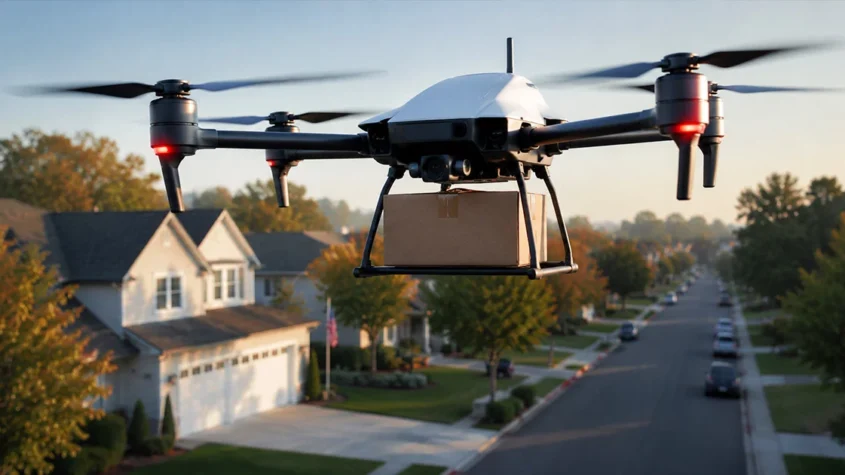
Waiting two days for an online order once felt incredibly fast.
Then came next-day delivery.
Then same-day delivery.
Now Amazon wants to make “30-minute package delivery” normal for millions more Americans—and the package may arrive without a delivery van ever entering the neighborhood.
Amazon revealed its plan to greatly expand its Prime Air drone program on August 19, 2035.
It is one of the most significant Prime Air drone program expansions in its history. The company wants to increase drone deliveries not only in 11 American cities but also in nearly 500 cities and communities by the close of 2035.
That represents roughly a sixfold expansion of Prime Air’s current geographic footprint.
For a program Jeff Bezos first publicly demonstrated in 2013, the announcement is significant.
Prime Air has spent more than a decade looking like an interesting technology experiment. Amazon now appears ready to turn it into a much more meaningful part of its logistics network.
And Amazon isn’t alone.
Walmart, Wing, Zipline, DoorDash, and Uber have each taken a different path in the realm of drone delivery, potentially ushering in a new era of last-mile delivery one of the most profound since the widespread adoption of same-day delivery services.
What Did Amazon Announce on August 19, 2026?
Amazon says Prime Air will reach “nearly 500 U.S. cities and towns before the end of 2026”.
Today, the service operates from 11 locations covering 10 major metropolitan areas across seven states:
- Arizona
- Florida
- Kansas
- Louisiana
- Michigan
- Nebraska
- Texas
Amazon says each Prime Air site can serve an area of approximately “175 square miles”.
Presently, the company has operations in several cities such as Tolleson, Arizona; Rustin, Florida; Kansas City, Kansas; Baton Rouge, Louisiana; Papillion, Nebraska; two sites in the Detroit area; and numerous Texas sites like Richardson, Richmond, San Antonio and Waco.
In addition, “Chicago, Atlanta, Syracuse, Cleveland, and Boise” have been pinpointed as the potential metro areas where Prime Air will debut new offerings. The target is ambitious.
Moving from a relatively small network of operating locations to hundreds of communities within a few months will test whether Amazon has finally solved enough of Prime Air’s technological, regulatory and economic problems to deploy it at serious scale.
How Fast Is Amazon Prime Air Delivery?
Amazon says eligible Prime Air orders can arrive in “as little as 30 minutes”. Most deliveries currently arrive roughly an hour after checkout. That puts Prime Air into a different category from traditional parcel delivery. Amazon isn’t trying to use drones to replace every delivery van. At least initially, the service is much better suited to situations where a customer needs a relatively small item quickly. Imagine realizing just before leaving home that you need a charging cable. Or running out of an ingredient while cooking.
Or needing an over-the-counter product, household item or small electronic accessory quickly.
Instead of a driver traveling across town with multiple packages, a drone can potentially fly directly between an Amazon facility and the customer’s delivery location.
That direct route is what gives the technology its speed advantage.
What Can Amazon Deliver by Drone?
Prime Air’s current MK30 drone has a payload limit of “5 pounds”.
That sounds restrictive until you look at how much of Amazon’s catalog falls below that threshold.
Amazon says more than “60% of the items customers most frequently purchase” can meet the service’s size and weight requirements.
Products available for drone delivery can include:
- Groceries
- Cosmetics
- Medications
- Household products
- Small electronics
- Smartphones and accessories
- Earbuds
- Trackers and other compact devices
Eligible products generally also need to fit inside a package roughly the size of a large shoebox. This explains why Amazon doesn’t need a drone capable of carrying a television or large bag of pet food for Prime Air to become commercially meaningful.
Small products make up a substantial share of urgent and frequently purchased orders.
How Much Does Amazon Drone Delivery Cost?
Amazon is pricing Prime Air at very competititve rates, as well. Prime members get drone delivery for free if they buy items worth at least $50. They will have to pay an extra cost of $2.99 for deliveries of less than $50. Non-Prime customers will have to pay $4.99, though. This is crucial since drone delivery wouldn’t turn into an everyday thing if people regard it as a novelty that is costly to acquire. The charging of almost $5 for delivery makes Prime Air very similar to regular e-commerce and local-delivery rates.
For some customers, especially when speed matters, that could make ordering an item from Amazon more attractive than driving to a nearby store.
How Does Amazon Prime Air Actually Work?
Prime Air is integrated into Amazon’s existing shopping experience.
Customers living in an eligible area see drone delivery as an option while shopping or during checkout.
After the order is prepared, an Amazon MK30 drone carries the package toward the customer’s selected delivery area.
When a drone is sent, the coordinates are not simply taken, and a parcel is dropped from the sky without care. Amazon claims that their drones are fitted with onboard cameras and sensors which allow them to scan the delivery spot for any possible obstacles people, vehicles and pets included. Only if the zone is unoccupied, the drone lands and releases the parcel from a safe altitude. The MK30 features Amazon’s “Detect-and-Avoid technology”, allowing the drone to keep track of its surroundings continuously and make autonomous flight safety decisions.
Amazon says camera data is processed onboard for navigation purposes rather than being monitored through a continuous live video feed.
Amazon’s MK30 Drone Is Built for Commercial Operations
Prime Air’s latest model, the MK30, is the outcome of years of work by their team at Prime Air redesigning their unmanned delivery machine.
The drone has the ability to travel no more than about “7.5 miles” from its base location before it has to return.
According to FAA filings, the total area covered by a prime air facility would be nearly 174 sq. miles.
Being an electric-powered aircraft, it was also made with the intention of performing well under a wider range of real-world conditions as compared to the previous generation Prime Air drones.
Amazon informs us that this product can be used during times of rainfall and will even tolerate a wide spectrum of temperatures.
Nearly anything a delivery service that requires perfect weather can do is likely not to be of much use commercially. That is why Amazon’s ability to operate in bad weather is really very important for their business model.
The Federal Aviation Administration has also granted Amazon **Part 135 air-carrier certification**, the regulatory framework required for commercial drone-delivery operations.
Prime Air Has Already Delivered Hundreds of Thousands of Packages in 2026
Amazon’s announcement isn’t based entirely on future expectations.
The company says Prime Air has already delivered “hundreds of thousands of packages by drone during 2026”.
Its busiest operating locations are completing thousands of deliveries per day.
Those numbers remain tiny compared with Amazon’s traditional delivery network.
But that’s not really the important comparison yet.
The more relevant question is whether drone delivery can move beyond a handful of experimental locations and become reliable enough to operate day after day across hundreds of communities.
Amazon’s 500-city expansion is designed to answer that question.
Walmart Is Already a Serious Drone Delivery Competitor
Amazon is not entering an empty market.
Walmart announced in May 2026 that it had completed its “one-millionth drone delivery”.
At the time, Walmart said its drone service operated from 66 stores across four states and five metropolitan markets.
The company works with drone operators including Wing and Zipline.
Walmart also revealed something important about customer behavior.
Around “40% of its first one million drone deliveries occurred in the first quarter of its 2027 fiscal year alone”, showing how rapidly adoption was accelerating.
Walmart reported an average drone-delivery time of about “23 minutes”, while its fastest recorded delivery took just “4 minutes and 44 seconds”.
This is one reason Amazon’s expansion matters.
The competitive question is no longer whether drone delivery can work.
Increasingly, it is about “which retailer can make it available to the largest number of customers”.
Wing and Walmart Are Building Their Own National Network
Alphabet-owned Wing is another major player.
Wing announced in June that its Walmart partnership was expanding into seven additional U.S. metro areas, including:
- Memphis
- New Orleans
- Philadelphia
- Phoenix
- San Diego
- San Francisco Bay Area
- Salt Lake City
Wing and Walmart plan to build a network covering more than “270 Walmart locations and over 40 million Americans by 2027”.
Wing also says it has completed well over “one million commercial drone deliveries”.
That puts Amazon’s Prime Air rollout into perspective.
Amazon may be accelerating quickly, but it is entering an increasingly competitive market.
DoorDash Is Now Becoming a Drone Operator Itself
In July 2026, DoorDash achieved another significant milestone. In a development which would be quite an industry first, the company received “FAA Part 135 air-carrier certification” for DoorDash Air a drone-delivery program which DoorDash had developed internally. This move wasn’t merely about DoorDash offering third-party drones through its app getting Part 135 certification means DoorDash will be able to commercially use its own drone-delivery service. It also reflects its vision of seamlessly linking the drone technology with its existing marketplace platforms, which millions of local restaurants, retailers and consumers already depend on. A move like that can really be beneficial as it will facilitate small, urgent local orders to get delivered through drones.
Uber and Zipline Want to Reach One Million Drone Deliveries a Day
Uber has entered the race as well.
In August 2026, Uber announced a major partnership with Zipline.
The companies plan to begin drone delivery in “Dallas and Houston before the end of 2026”, with additional U.S. expansion expected later.
Their long-term ambition is extraordinary:
“one million drone deliveries per day by 2029.”
Uber Eats currently relies heavily on human couriers.
If drones become efficient for selected short-distance orders, they could eventually handle some trips that currently require a driver or cyclist.
The emphasis is on some.
Drones cannot carry every restaurant order, operate everywhere or solve every last-mile problem.
But for small, time-sensitive deliveries, they could become a meaningful part of the network.
Safety Remains Prime Air’s Biggest Test
Fast delivery means very little if the system can’t operate safely.
Amazon has already learned that lesson.
On “October 1, 2025”, two Amazon MK30 drones collided with the boom of a mobile crane in Tolleson, Arizona.
Both drones were substantially damaged.
No serious injuries were reported, but the incident triggered investigations by the FAA and National Transportation Safety Board.
Amazon temporarily paused local operations and later resumed them after conducting its own review.
The incident illustrates one of the hardest problems in autonomous flight.
A drone may have an accurate digital map of permanent buildings and terrain.
But urban and suburban environments change.
Cranes appear.
Temporary cables may be installed.
Construction zones develop.
Amazon faced another issue in November 2025 when a Prime Air drone struck an overhead internet cable in Waco, Texas.
Again, there were no reported injuries.
But incidents like these show why scaling from thousands to potentially millions of autonomous flights is not simply a matter of manufacturing more drones.
Why Low-Altitude Airspace Is So Difficult
Delivery drones typically fly at relatively low altitude.
That’s convenient for short trips but also puts them into an environment filled with obstacles.
Those can include:
- Trees
- Power and communication lines
- Construction crane
- Buildings
- Other drones
- Birds
- Temporary structures
- Changing weather
Detect-and-Avoid systems are getting better, but no autonomous aviation technology should be treated as incapable of making mistakes.
As drone traffic increases, regulators will need to think about how multiple commercial operators safely share the same low-altitude airspace.
That could eventually become almost like an invisible road network above cities.
Drone Delivery Could Change the Meaning of “Fast Shipping”
Amazon has spent years shortening delivery expectations.
Two-day Prime delivery once transformed online shopping.
Then one-day delivery became increasingly common.
Same-day delivery followed.
Now Amazon Now and Prime Air are pushing toward sub-hour delivery.
That changes the psychology of e-commerce.
If a small item can arrive in 30 minutes, online shopping begins competing not simply with another website but with the convenience of going to a nearby physical store.
That’s strategically important for Amazon.
The faster delivery becomes, the less reason customers have to leave Amazon’s ecosystem when they urgently need something.
Will Drones Replace Amazon Delivery Drivers?
Not anytime soon.
Prime Air’s current weight limit alone prevents drones from delivering a large share of heavier orders.
Weather, local regulations, customer locations and landing-area requirements create additional limitations.
Traditional vans can also carry hundreds of packages simultaneously, making them extremely efficient for dense delivery routes.
Drone delivery is therefore better understood as another layer in Amazon’s logistics system.
For example:
Traditional vans: large numbers of normal deliveries.
Same-day network: urgent orders requiring delivery within several hours.
Amazon Now: selected everyday goods delivered in around 30 minutes in supported markets.
Prime Air: lightweight items delivered rapidly by autonomous drone.
The delivery network of the future will probably use several methods rather than one replacing everything else.





Apple Pay Finally Launches in India: 12 Years After It Launched Everywhere Else
Apple Pay debuted in the US back in 2014. It took twelve years, but it finally arrived in …

Why 71% of Indian Homebuyers Are Now Choosing ₹1 Crore+ Homes in 2026
There’s a number floating around in property circles right now that genuinely stops people …