


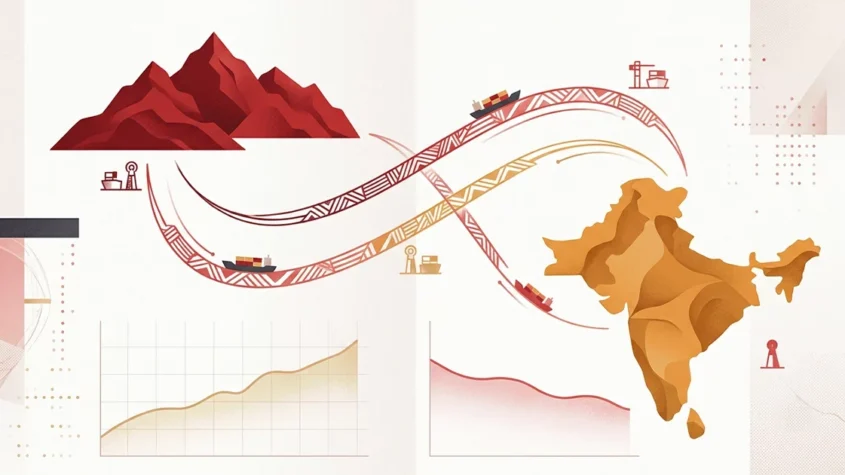
Swiss President Guy Parmelin arrived in New Delhi this week for a three-day state visit, timed deliberately around a milestone: the first anniversary of the India-EFTA Trade and Economic Partnership Agreement, which came into force in October 2025. A year in is exactly the right moment to ask the question everyone glosses over when a trade deal is signed — did it actually do anything? Here’s what the real numbers say.
What TEPA actually is, for anyone who missed the original deal?
The European Free Trade Association isn’t the European Union — it’s a separate four-country bloc comprising Switzerland, Norway, Iceland, and Liechtenstein. India’s Trade and Economic Partnership Agreement with this group entered into force in October 2025, after years of on-and-off negotiation, and represented a significant trade policy milestone specifically because Switzerland is by far the largest of the four EFTA economies and, according to India’s own foreign ministry, remains India’s biggest trade and investment partner within the bloc.
Parmelin’s current visit — his first State visit to India, though his second trip of the year after attending the AI Impact Summit in February — is built around the second India-EFTA Prosperity Summit, held October 7, specifically to mark TEPA’s one-year anniversary and take stock of how implementation has actually gone.
The investment number that looks good on paper
Government data cited around the visit shows Swiss investment into India increased by $202.10 million since TEPA took effect — climbing from $11,114.32 million as of September 2025 to $11,316.42 million by March 2026. On its face, that’s a positive, measurable sign that a trade agreement widely discussed in the abstract for years has started translating into real capital flows within its first six months of operation.
It’s worth being honest about scale here, though: $202 million in additional investment against an existing base of over $11 billion is a roughly 1.8% increase — a genuinely positive direction, but a modest one in percentage terms, especially set against a one-year window that included considerable advance publicity and diplomatic effort around the deal’s signing.
The part that didn’t go as planned: India’s exports actually declined
Here’s the detail that’s easy to miss in coverage focused primarily on investment figures, and it’s worth stating plainly because it complicates a purely positive narrative: India’s exports to EFTA nations have declined since TEPA came into force, according to the same reporting covering Parmelin’s visit. That’s a genuinely uncomfortable data point for a trade agreement specifically designed, at least in part, to boost bilateral trade flows in both directions — and it’s a useful reminder that a trade deal taking effect doesn’t automatically translate into immediate export growth for either side, particularly within a single year that’s also subject to broader global trade conditions unrelated to the agreement itself.
It’s worth noting what reporting on the visit didn’t fully break down: the specific sectors driving that export decline, or whether it reflects a temporary adjustment period versus a more structural trend. That’s the kind of detail worth watching for as more granular trade data becomes available over the coming months, rather than a question this first-year snapshot fully answers.
What the two sides actually discussed this week?
Beyond the trade numbers themselves, the visit’s agenda — confirmed by India’s Ministry of External Affairs — covered a genuinely broad scope: trade and investment, science, technology and innovation, mobility, culture, and people-to-people contact, with Prime Minister Modi and President Parmelin holding direct bilateral discussions on October 5, followed by a state banquet hosted by President Droupadi Murmu at Rashtrapati Bhavan the same evening. External Affairs Minister S. Jaishankar also met separately with Parmelin during the visit, alongside the high-level business delegation that accompanied the Swiss President.
Parmelin’s own public remarks during the visit struck a notably positive tone regardless of the mixed trade figures — he described implementing TEPA positively and said he expected it to boost bilateral trade in the coming years, framing the relationship as built on shared democratic values, trust, and mutual respect. He also specifically praised India’s role at the AI Impact Summit earlier in the year, saying Switzerland intended to “build on this,” and characterized India as an increasingly important actor in global governance, advocating for a stronger India-Switzerland partnership specifically in the context of what he described as broader global fragmentation.
Why this particular trade relationship matters beyond the immediate numbers?
It’s worth situating TEPA within India’s broader 2026 trade strategy rather than treating it as an isolated deal. This same year has seen India also reach a separate free trade agreement with the European Union (announced in late January) and renegotiate its tariff relationship with the United States (the February deal that cut combined tariffs from roughly 50% to 18%, discussed in our earlier coverage). Taken together, 2026 has genuinely been a year of India actively reshaping several of its largest trade relationships in parallel, rather than any single deal representing an isolated diplomatic event.
For businesses and investors tracking India’s trade policy direction, TEPA’s first-year results offer a useful, if imperfect, data point: trade and investment agreements of this scale typically take considerably longer than twelve months to show their full effect, and a modest investment increase alongside a genuine export decline is a realistic, rather than either triumphant or alarming, snapshot of where implementation actually stands partway through what’s likely to be a multi-year process.
What to watch from here?
The most useful signal going forward isn’t this week’s diplomatic ceremony itself, but whether the second-year trade data — covering the period after this anniversary review — shows the export decline reversing, or whether it persists as a more structural pattern worth genuine policy attention. Given that both governments have now publicly committed, through this Prosperity Summit, to reviewing implementation and “charting the way forward” rather than simply celebrating the anniversary, it’s reasonable to expect concrete follow-up measures addressing specific sectors or trade barriers to emerge from this visit, rather than the relationship simply continuing on its current trajectory unchanged.
Trade and investment figures reflect official government data cited around President Parmelin’s October 2026 visit and are subject to revision as more complete trade statistics become available. This article explains recent trade developments for informational purposes and isn’t investment advice.