

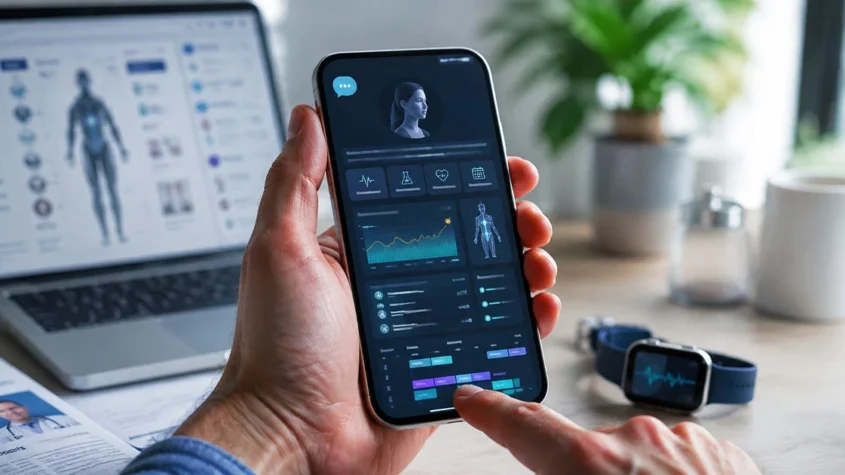
Your medical information is probably scattered across more places than you realize.
Blood tests are in one portal. Prescriptions are somewhere else. Your smartwatch knows how much you slept last night. A fitness app knows how active you were. Your doctor’s notes may be sitting inside a hospital system you rarely open.
Then, when you have a question about your health, you are expected to put all of that information together yourself.
That is the problem companies such as OpenAI, Microsoft and Amazon are trying to solve with their new health AI products.
In 2026, the three technology giants moved beyond the idea of simply asking a general chatbot a health question. They started building dedicated experiences that can work with a person’s own health information.
OpenAI calls its product Health in ChatGPT.
Microsoft has Copilot Health.
Amazon has Health AI, backed by its One Medical healthcare business.
They are not identical products, and they should not be treated as digital versions of a doctor.
But they do represent a significant change in how people may interact with their own health data.
Why Did All of This Happen in 2026?
The timing is hard to ignore. Health questions were already extremely popular on consumer AI platforms.
OpenAI said more than 230 million people globally asked health and wellness questions on ChatGPT every week in January 2026. By July, OpenAI reported that more than 300 million people were asking health-related questions each week.
So the demand was already there. What was missing was personal context. A normal chatbot can explain what an HbA1c test is.
But a health assistant connected to your records can potentially help you understand your own result and compare it with previous information you’ve chosen to share.
That is a much more useful question. It is also a much more sensitive one.
ChatGPT Health: Personal Context Inside ChatGPT
OpenAI introduced ChatGPT Health in January and began a broader rollout to eligible U.S. users aged 18 and older on July 23, 2026. The experience is available on web and iOS and is being rolled out gradually.
Users can choose to connect supported health information.
OpenAI currently lists Apple Health, supported U.S. provider records, One Medical and Function Health among the available connections.
The useful part isn’t simply storing information.
It is being able to ask questions about it.
For example:
- What changed between my last two test results?
- Help me prepare for my next appointment.
- Can you explain this medical term in plain English?
- What trends do you see in my recent activity and sleep?
These are the kinds of tasks where personal context can make an AI response considerably more useful.
OpenAI says Health is designed to support—not replace—medical care and is not intended for diagnosis or treatment.
Microsoft Copilot Health: A Separate Health Workspace
Microsoft’s approach is similar, but the product has its own structure.
Copilot Health is designed as a dedicated space inside Copilot for private health questions.
Microsoft says users can connect their own health records and wearable information if they want more personalized answers. The company specifically describes uses such as understanding lab results, spotting trends and preparing for conversations with a doctor.
Microsoft announced Copilot Health in March and moved it into preview in May after testing it with thousands of users. The preview was initially aimed at U.S. users aged 18 and older with eligible Microsoft 365 subscriptions.
This staged approach is significant.
Microsoft is not presenting Copilot Health as a replacement for a physician.
Its own documentation says it is not intended to diagnose or treat medical conditions.
That makes its intended role fairly clear: help people understand their information and prepare for actual healthcare conversations.
Amazon Health AI Is More Closely Connected to Care
Amazon’s Health AI has one major difference.
It is tied directly to One Medical.
Amazon introduced an agentic Health AI assistant through One Medical in January 2026 and later launched Health AI on the Amazon U.S. website and app.
The assistant can answer health questions and provide personalized guidance, but it can also take certain actions with permission.
Amazon says Health AI can:
- Explain health information
- Read health records
- Help interpret laboratory results
- Manage prescription renewals
- Book appointments
- Connect customers with One Medical providers
That makes Amazon’s approach more action-oriented than a simple question-and-answer chatbot. If a user needs professional care, the system can help move the conversation toward a real healthcare provider. That is an important difference.
What Can a Personal Health AI Actually Help With?
Forget the marketing language for a moment. The everyday usefulness comes down to a handful of fairly simple tasks.
Understanding Medical Information
Medical reports aren’t written for casual reading. A laboratory report can contain abbreviations, reference ranges and technical terms that mean very little to someone without a medical background.
AI can translate that language into something easier to understand. That doesn’t make the explanation a diagnosis. It simply makes the information less intimidating.
Comparing Health Information Over Time
This may be one of the strongest use cases.
One isolated number doesn’t always tell you much.
Changes over time can be more useful.
A health assistant can potentially help you organize previous and current information so that you can ask your healthcare provider better questions.
Preparing for Appointments
Many patients walk out of a doctor’s office and realize they forgot to ask something important.
AI can help create a list beforehand.
You can describe what has changed, list your concerns and ask the assistant to organize the information into questions for your appointment.
That can make a short appointment more productive.
Understanding Wearable Data
Smartwatches and fitness trackers generate huge amounts of information.
- Sleep duration.
- Heart-rate measurements.
- Activity.
- Exercise.
- Sometimes the problem isn’t a lack of data.
- It’s too much data.
An AI assistant may help identify patterns and turn a collection of disconnected numbers into something easier to discuss.
Keeping Health Information Organized
This sounds boring, but it may become one of the most useful features.
Instead of searching through old PDFs, emails and apps, people may increasingly expect their personal health assistant to help them find and understand their own information.
The Big Difference: Information vs Action
This is where the three approaches become interesting.
ChatGPT Health is strongly focused on bringing personal health context into conversations and helping users understand and navigate their information.
Copilot Health similarly focuses on private health questions, connected health data, trends and appointment preparation.
Amazon Health AI adds a stronger connection to healthcare actions through One Medical, including appointment booking and prescription-related tasks.
In simple terms:
| Platform | Main strength |
|---|---|
| ChatGPT Health | Understanding and organizing personal health information |
| Copilot Health | Health questions, trends and appointment preparation |
| Amazon Health AI | Personalized guidance plus connection to healthcare actions |
That doesn’t mean one product is universally better.
It means they are being built around slightly different ideas of what a health assistant should be.
The Privacy Problem Nobody Should Ignore
The convenience is obvious.
The privacy question is harder.
Connecting a health assistant to your records means giving a technology platform access to some of the most personal information you have.
That can include:
- Medical records
- Laboratory results
- Prescription information
- Activity data
- Sleep information
- Wellness information
- Health-related conversations
The protections aren’t identical across services.
OpenAI says Health in ChatGPT is not intended for clinical or covered-entity use and does not offer a Business Associate Agreement.
Amazon says its One Medical Health AI uses HIPAA-compliant privacy and security protections.
So users shouldn’t simply assume:
“It’s a health product, therefore HIPAA applies.”
That’s too broad.
The correct approach is to check the privacy terms of the specific product you are using.
Can You Trust an AI With a Lab Result?
This is where some common sense is necessary.
AI can be very good at explaining information.
That doesn’t mean it should make medical decisions for you.
Suppose an AI tells you that a laboratory result is outside the usual reference range.
That is useful information.
But the next question—why is it abnormal in this particular person?—may require medical history, physical examination, additional tests and professional judgment.
An AI does not automatically have all of those things.
Even when it has access to your connected records, it may not have the complete clinical picture.
So a useful rule is: Use AI to understand the question. Use a healthcare professional to decide what the question means for your treatment.
What About AI Making a Dangerous Mistake?
This is one of the biggest concerns around consumer health AI. A chatbot can produce a confident answer that is incomplete or wrong. There is another problem too.
Sometimes an answer can be technically reasonable but still inappropriate for a particular person because important context is missing. That’s why Microsoft’s product guidance explicitly says Copilot Health is not intended to diagnose or treat medical conditions.
OpenAI gives similar guidance for ChatGPT Health. The safest role for these systems is therefore much narrower than “AI doctor.”
Think: explainer + organizer + preparation assistant.
Not: replacement for your doctor.
Why Wearables Could Make Health AI More Useful
There is an interesting second layer to this story.
Medical records are mostly snapshots.
A blood test might happen once every few months.
A wearable can collect information every day.
That creates the possibility of combining clinical information with lifestyle data.
For example, a person could potentially look at changes in sleep, activity and exercise alongside other health information.
That doesn’t automatically reveal a medical cause.
But it may help the person notice something worth discussing with a healthcare professional.
OpenAI’s Health experience already supports Apple Health and can use information shared from compatible apps through it.
This is where consumer health AI could become more interesting over time.
The future may not be about asking an AI one medical question.
It may be about having an assistant that understands a longer timeline of your health information.
What Should You Do Before Connecting Your Health Data?
If you’re considering trying one of these products, don’t rush through the permissions screen.
First, find out what information you’re actually giving the service.
Then check:
- What data is collected?
- Where is it stored?
- How is it used?
- Is it used to train AI models?
- Can you delete the information later?
- Which third-party services receive the data?
- What happens if you disconnect the account?
These questions may feel excessive when you’re trying to get a simple answer about a blood test.
They aren’t. Health data deserves more attention than ordinary app data.
Are AI Health Assistants Actually Useful?
Yes—but probably not for the reason some people expect.
Their biggest value may not be diagnosing mysterious illnesses.
It may be helping ordinary people deal with the frustrating administration of modern healthcare.
- Finding information.
- Understanding terminology.
- Comparing old and new reports.
- Remembering questions.
- Preparing for appointments.
- Keeping track of changes.
- Those are small problems individually.
- Together, they make healthcare much easier to navigate.
And that’s exactly where consumer AI may have a meaningful role.
The Health AI Race Is Only Getting Started
OpenAI, Microsoft and Amazon have now put their own versions of personal health AI in front of consumers.
The products are still young.
Features will change.
Privacy policies will evolve.
Connections to medical records and wearable platforms will expand.
Regulators will continue to examine how these systems should operate.
And users will gradually discover which features are genuinely useful and which ones are mostly marketing.
The biggest mistake would be to think that 2026 created the AI doctor.
It didn’t.
What 2026 created is something more practical: the beginning of a category of AI tools that can sit between a person and the enormous amount of health information they already have.
That could turn out to be much more useful than a chatbot pretending to know everything.
Frequently Asked Questions
What is the difference between ChatGPT Health and regular ChatGPT?
ChatGPT Health is a dedicated health experience designed to work with health information that users choose to connect. It can use supported medical records and Apple Health data to provide more personalized context.
Is Microsoft Copilot Health available to everyone?
No. Microsoft says Copilot Health is being rolled out in preview to eligible U.S. users aged 18 and older with certain Microsoft 365 subscriptions.
What makes Amazon Health AI different?
Amazon connects its Health AI experience with One Medical, allowing the system to provide personalized health guidance and take certain actions with permission, such as booking appointments and managing prescriptions.
Can ChatGPT Health access my smartwatch data?
ChatGPT Health can use information shared through Apple Health. Compatible wearable and fitness apps can therefore contribute data when they share it with Apple Health and the user permits access.
Should I use AI to diagnose myself?
No. Consumer health AI products are designed to support understanding and preparation rather than replace professional diagnosis or treatment. If you’re concerned about symptoms or a test result, use the AI response as a starting point for a conversation with a qualified healthcare professional.
Is every AI health assistant HIPAA-protected?
No. Privacy and regulatory treatment differs between products. Users should check the specific service’s privacy documentation rather than assuming that every consumer health AI product falls under HIPAA.






Apple Pay Finally Launches in India: 12 Years After It Launched Everywhere Else
Apple Pay debuted in the US back in 2014. It took twelve years, but it finally arrived in …

Why 71% of Indian Homebuyers Are Now Choosing ₹1 Crore+ Homes in 2026
There’s a number floating around in property circles right now that genuinely stops people …