


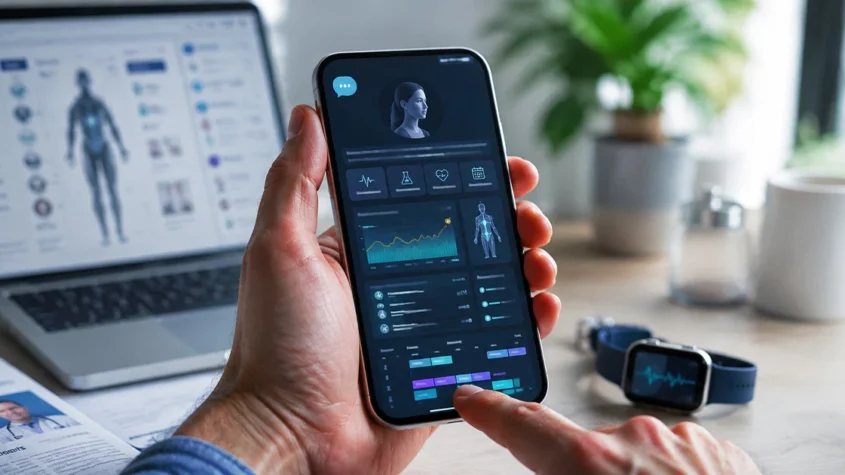
Your medical information is probably scattered across more places than you realize.
Blood tests are in one portal. Prescriptions are somewhere else. Your smartwatch knows how much you slept last night. A fitness app knows how active you were. Your doctor’s notes may be sitting inside a hospital system you rarely open.
Then, when you have a question about your health, you are expected to put all of that information together yourself.
That is the problem companies such as OpenAI, Microsoft and Amazon are trying to solve with their new health AI products.
In 2026, the three technology giants moved beyond the idea of simply asking a general chatbot a health question. They started building dedicated experiences that can work with a person’s own health information.
OpenAI calls its product Health in ChatGPT.
Microsoft has Copilot Health.
Amazon has Health AI, backed by its One Medical healthcare business.
They are not identical products, and they should not be treated as digital versions of a doctor.
But they do represent a significant change in how people may interact with their own health data.
Why Did All of This Happen in 2026?
The timing is hard to ignore. Health questions were already extremely popular on consumer AI platforms.
OpenAI said more than 230 million people globally asked health and wellness questions on ChatGPT every week in January 2026. By July, OpenAI reported that more than 300 million people were asking health-related questions each week.
So the demand was already there. What was missing was personal context. A normal chatbot can explain what an HbA1c test is.
But a health assistant connected to your records can potentially help you understand your own result and compare it with previous information you’ve chosen to share.
That is a much more useful question. It is also a much more sensitive one.
ChatGPT Health: Personal Context Inside ChatGPT
OpenAI introduced ChatGPT Health in January and began a broader rollout to eligible U.S. users aged 18 and older on July 23, 2026. The experience is available on web and iOS and is being rolled out gradually.
Users can choose to connect supported health information.
OpenAI currently lists Apple Health, supported U.S. provider records, One Medical and Function Health among the available connections.
The useful part isn’t simply storing information.
It is being able to ask questions about it.
For example:
- What changed between my last two test results?
- Help me prepare for my next appointment.
- Can you explain this medical term in plain English?
- What trends do you see in my recent activity and sleep?
These are the kinds of tasks where personal context can make an AI response considerably more useful.
OpenAI says Health is designed to support—not replace—medical care and is not intended for diagnosis or treatment.
Microsoft Copilot Health: A Separate Health Workspace
Microsoft’s approach is similar, but the product has its own structure.
Copilot Health is designed as a dedicated space inside Copilot for private health questions.
Microsoft says users can connect their own health records and wearable information if they want more personalized answers. The company specifically describes uses such as understanding lab results, spotting trends and preparing for conversations with a doctor.
Microsoft announced Copilot Health in March and moved it into preview in May after testing it with thousands of users. The preview was initially aimed at U.S. users aged 18 and older with eligible Microsoft 365 subscriptions.
This staged approach is significant.
Microsoft is not presenting Copilot Health as a replacement for a physician.
Its own documentation says it is not intended to diagnose or treat medical conditions.
That makes its intended role fairly clear: help people understand their information and prepare for actual healthcare conversations.
Amazon Health AI Is More Closely Connected to Care
Amazon’s Health AI has one major difference.
It is tied directly to One Medical.
Amazon introduced an agentic Health AI assistant through One Medical in January 2026 and later launched Health AI on the Amazon U.S. website and app.
The assistant can answer health questions and provide personalized guidance, but it can also take certain actions with permission.
Amazon says Health AI can:
- Explain health information
- Read health records
- Help interpret laboratory results
- Manage prescription renewals
- Book appointments
- Connect customers with One Medical providers
That makes Amazon’s approach more action-oriented than a simple question-and-answer chatbot. If a user needs professional care, the system can help move the conversation toward a real healthcare provider. That is an important difference.
What Can a Personal Health AI Actually Help With?
Forget the marketing language for a moment. The everyday usefulness comes down to a handful of fairly simple tasks.
Understanding Medical Information
Medical reports aren’t written for casual reading. A laboratory report can contain abbreviations, reference ranges and technical terms that mean very little to someone without a medical background.
AI can translate that language into something easier to understand. That doesn’t make the explanation a diagnosis. It simply makes the information less intimidating.
Comparing Health Information Over Time
This may be one of the strongest use cases.
One isolated number doesn’t always tell you much.
Changes over time can be more useful.
A health assistant can potentially help you organize previous and current information so that you can ask your healthcare provider better questions.
Preparing for Appointments
Many patients walk out of a doctor’s office and realize they forgot to ask something important.
AI can help create a list beforehand.
You can describe what has changed, list your concerns and ask the assistant to organize the information into questions for your appointment.
That can make a short appointment more productive.
Understanding Wearable Data
Smartwatches and fitness trackers generate huge amounts of information.
- Sleep duration.
- Heart-rate measurements.
- Activity.
- Exercise.
- Sometimes the problem isn’t a lack of data.
- It’s too much data.
An AI assistant may help identify patterns and turn a collection of disconnected numbers into something easier to discuss.
Keeping Health Information Organized
This sounds boring, but it may become one of the most useful features.
Instead of searching through old PDFs, emails and apps, people may increasingly expect their personal health assistant to help them find and understand their own information.
The Big Difference: Information vs Action
This is where the three approaches become interesting.
ChatGPT Health is strongly focused on bringing personal health context into conversations and helping users understand and navigate their information.
Copilot Health similarly focuses on private health questions, connected health data, trends and appointment preparation.
Amazon Health AI adds a stronger connection to healthcare actions through One Medical, including appointment booking and prescription-related tasks.
In simple terms:
| Platform | Main strength |
|---|---|
| ChatGPT Health | Understanding and organizing personal health information |
| Copilot Health | Health questions, trends and appointment preparation |
| Amazon Health AI | Personalized guidance plus connection to healthcare actions |