

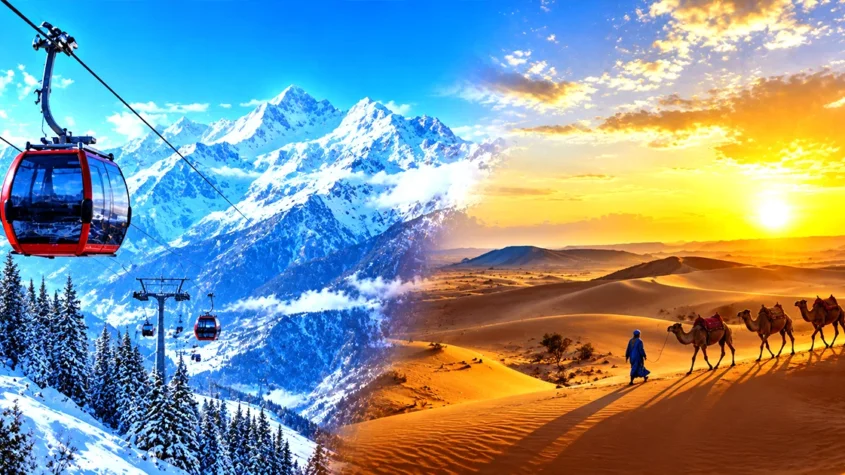
Winter is arguably India’s most forgiving travel season — the same few months deliver snow-covered Himalayan passes, warm southern beaches, and desert festivals under clear skies, all within the same country. The tricky part isn’t finding somewhere beautiful to go; it’s matching the right destination to the right week, since “winter in India” actually spans wildly different conditions depending on where you point the compass.
The two very different Indias of winter travel
Split winter travel into two broad categories, because trying to compare them directly doesn’t make sense. Northern and Himalayan India goes properly cold — Northeast India sees cool, misty conditions around 10-18°C, ideal for trekking and landscape photography, while high-altitude destinations like Ladakh can plummet below -20°C, a genuinely extreme environment that demands serious preparation rather than casual sightseeing gear.
During those very months when parts of inland and southern India have the warm temperatures of 20-30°C, the beaches and islands become very attractive. That’s why this time is referred to as the real monsoon escape because one gets to choose between staying dry and hot or cold and wet. Should you be contemplating “a snow adventure” or “a trip to the seashore” this winter, both are actually peak-season offers; you’re just at the opposite ends of the same calendar.
For snow and skiing: Gulmarg and Auli lead for good reason
Gulmarg, in Jammu & Kashmir, is consistently ranked as Asia’s premier skiing destination, and January marks its actual peak season — pristine powder, clear skies, and conditions suited to both beginners and advanced skiers. The Gulmarg Gondola is worth building a trip around on its own merits: it’s one of the highest cable cars in the world, climbing to around 4,000 metres for genuinely dramatic Himalayan views, whether or not you’re there to ski.
Auli, in Uttarakhand, is the other major skiing destination worth knowing, with sweeping views of Nanda Devi, Kamet, and Mana Parvat, and its own long ropeway offering aerial views for non-skiers. Here’s a specific, useful planning detail: if you’re hoping to catch competitive skiing rather than just recreational slopes, Auli hosts the National Winter Games during February and March, which is worth timing a visit around if watching competitive events adds to the trip for you.
Manali and Shimla remain the more accessible, infrastructure-heavy options for a snow trip that doesn’t require the same logistical planning as Gulmarg or Auli — Shimla’s toy train and Mall Road, and Manali’s Solang Valley and Rohtang Pass (winter-access only), both deliver a snow experience without demanding the same level of cold-weather expertise.
For something rawer: Ladakh and Tawang
Places you can visit for really dramatic, less-touristed winter scenery are Ladakh and Tawang (in Arunachal Pradesh). Planning to get there will be a bit more time-consuming but totally worth it. Winter at Ladakh means frozen rivers, silent valleys, and monasteries covered in snow; it’s a landscape that is hard to believe and that really deserves your effort and dedication because even in those beautiful landscapes it can get pretty cold. Tawang as well is located above 10, 000 ft, and besides being a pretty place it can also have some problems: the Sela Pass usually gets blocked because of snow and the Madhuri Lake freezes thoroughly during the depths of winter. A few facts worth knowing beforehand: Even Indian tourists must obtain permits to visit Tawang, so Tawang is not a place on which you can go spontaneous trip by just booking a flight and going, you must complete some paperwork and clearances ahead time before heading for Tawang.
For warmth instead of snow: Goa, Kerala, and the deserts
If cold isn’t the appeal, winter is genuinely the best time to head toward Goa, Kerala’s backwaters, or Rajasthan’s desert landscapes instead. Goa’s winter season, running through the same months as the Himalayan ski season, is its actual peak — comfortable temperatures, the Sunburn Festival typically held in late December, and considerably better conditions for beach activities than the humid off-season. For something quieter than North Goa’s party scene, South Goa’s beaches like Palolem offer a more relaxed version of the same season.
Rajasthan’s desert destinations come alive in a genuinely different way during winter. Jaisalmer’s Desert Festival, typically held in January, is one of the state’s most anticipated annual events, set against the backdrop of Jaisalmer Fort in the Thar Desert. The Great Rann of Kutch, in Gujarat, is similarly at its most accessible and spectacular during the cooler months — its salt marshes are genuinely difficult to appreciate in the region’s brutal summer heat, which is part of why winter is specifically when this destination makes sense.
The practical planning advice that actually matters
A few things worth doing differently for winter travel specifically, rather than treating it like any other trip:
Match your gear to your actual destination category, not a generic “winter trip” packing list. A trip to Gulmarg or Ladakh needs genuinely serious cold-weather gear — the kind of preparation you’d take for any snow-sport destination internationally — while a Goa or Kerala winter trip needs essentially none of that. Conflating the two categories when packing is one of the most common and avoidable mistakes.
Check permit requirements early for border and high-altitude regions. Tawang isn’t the only destination in this category — several parts of the Northeast and high-altitude Himalayan regions require inner-line permits or special authorization, and this paperwork can take real time to process. If your destination falls into this category, sort it well before finalizing flights.
Book skiing-specific accommodation and lift passes early if you’re targeting peak windows. Gulmarg’s January peak and Auli’s February-March Winter Games period both draw concentrated demand, and ski-adjacent accommodation in particular tends to book out faster than general tourism infrastructure in the same towns.
Don’t assume “winter” means the same weather nationally. With a 30-40°C practical temperature range across different regions during the exact same calendar weeks, checking destination-specific forecasts matters more for a winter India trip than it typically would for other seasons, where regional variation tends to be somewhat narrower.
The bottom line
India’s winter season genuinely earns its reputation as the country’s most versatile travel window — the same few months support a ski trip to Gulmarg, a desert festival in Jaisalmer, and a beach holiday in Goa, without any of those experiences competing for the same travel dates. The practical work is simply picking which version of winter you actually want, then planning gear, permits, and booking timelines around that specific category rather than a generic “winter trip” template that doesn’t really fit any of these destinations individually.





Inside India’s Edtech Reset: What the Unacademy-upGrad Deal Actually Signals
Six years to the day after Unacademy became a unicorn, its founder posted the number that …

How to Document a Business Process in 90 Minutes (Before You Automate Anything)
You can reduce your headache by documenting a business process. It is simple to …