
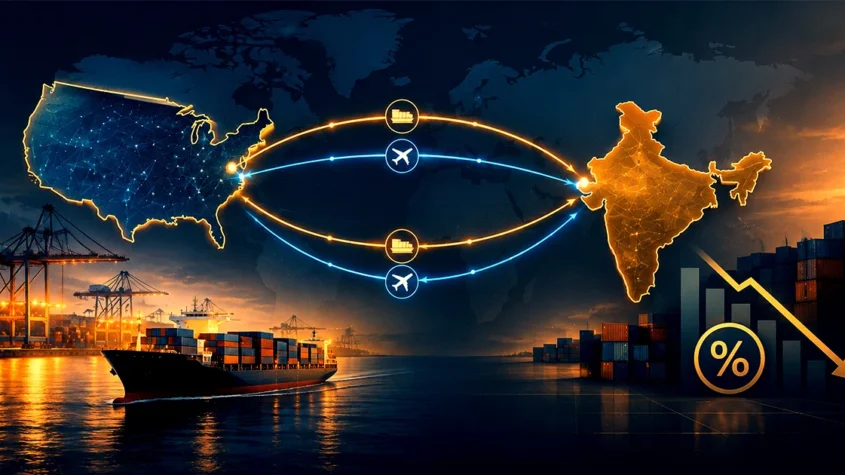
For much of 2025, Indian exporters were staring down some of the steepest US tariffs faced by any major trading partner — a combined rate touching roughly 50% on many goods. By early February 2026, that number had been cut to 18%. Here’s what actually happened, why it happened, and what it means for anything you buy that’s made in India, or any Indian business that sells into the US market.
How the tariffs got to 50% in the first place?
The story starts with two separate layers of tariffs stacking on top of each other. The first was a 25% “reciprocal” tariff that President Trump applied broadly across dozens of trading partners as part of his wider trade policy — India was one of many countries hit by this general measure. The second was a separate, additional 25% punitive tariff applied specifically to India, tied directly to India’s continued purchases of discounted Russian crude oil following the 2022 invasion of Ukraine. Together, these two layers pushed the effective tariff rate on many Indian goods to roughly 50% — among the highest rates any major US trading partner was facing at the time.
India had leaned into cheap Russian oil precisely because much of the world had pulled back from Moscow following the invasion, leaving India (along with a handful of other countries) able to buy crude at a meaningful discount. That decision, sound from a pure economics standpoint, became the direct trigger for Washington’s punitive tariff layer.
The deal that changed it: February 2, 2026
On February 2, 2026, President Trump announced via social media that he would cut the reciprocal tariff on India from 25% to 18%, and separately confirmed the US was rescinding the additional 25% punitive duty tied to Russian oil purchases entirely — bringing the combined effective rate down from roughly 50% to 18%, a genuinely significant reduction for Indian exporters.
The announcement came directly out of a phone call between Trump and Prime Minister Modi. In exchange, Modi reportedly committed to India reducing its own tariffs and trade barriers on US goods to zero, and to purchasing more than $500 billion worth of American energy, technology, agricultural, and other products. Trump framed India’s shift away from Russian oil specifically as a contribution toward ending the war in Ukraine, posting that the move would “help end the war in Ukraine, which is taking place right now, with thousands of people dying each and every week.”
Modi’s own public response was notably warm and specific about the tariff relief: “Delighted that Made in India products will now have a reduced tariff of 18%,” he posted, thanking Trump “on behalf of the 1.4 billion people of India.” Worth noting precisely what each leader emphasized in their public statements: Modi’s post focused entirely on the tariff reduction and didn’t directly address the Russian oil commitment, while Trump’s framing centered heavily on the oil angle — a small but telling difference in how each side chose to present the same deal to their respective audiences.
Why this wasn’t actually the first such announcement?
Here’s a detail worth knowing if you want the full picture rather than just the headline outcome: this wasn’t the first time Trump had claimed India agreed to halt Russian oil purchases. A similar announcement had been made months earlier, in October, but Indian refiners reportedly continued buying Russian crude despite that claim. It was only after the US subsequently imposed direct sanctions on Russia’s two largest oil producers, Rosneft and Lukoil, later in October, that Indian appetite for Russian crude actually diminished significantly — suggesting the sanctions on the oil companies themselves, rather than the diplomatic pressure alone, were what actually shifted India’s purchasing behavior on the ground.
That timeline matters for understanding February’s deal correctly: it wasn’t a sudden, isolated diplomatic breakthrough so much as the formal trade conclusion to a months-long process that had already been reshaping India’s oil purchasing decisions through direct sanctions pressure.
What this actually meant for Indian goods and businesses?
The practical impact fell hardest on specific sectors. Textiles, machinery, and several other categories of Indian exports had been particularly exposed to the 50% combined rate, and the reduction to 18% represented a genuinely significant competitive improvement for Indian exporters selling into the US market compared to where things stood through much of 2025.
The deal also arrived in a broader context worth noting: it came just days after India and the European Union announced they had concluded negotiations on their own free trade agreement, following more than a decade of on-and-off talks. Seen together, early 2026 marked a period of India significantly reshaping its major trade relationships on two fronts simultaneously — formalizing a long-delayed EU agreement while resetting its most contentious trade dispute with the US, within the same general window.
What analysts said about the deal’s real significance?
Rachel Ziemba, an adjunct senior fellow at the Center for a New American Security, was quoted at the time noting simply that “the deal has definitely been some time in coming” — a fairly understated way of capturing what had, by that point, been many months of trade tension, tariff escalation, and diplomatic back-and-forth between the two countries.
It’s also worth being clear-eyed about the deal’s specific mechanics: the $500 billion in purchase commitments Modi reportedly made covers energy, technology, agricultural, and coal products, spanning what would presumably be a multi-year purchasing window rather than a single-year figure — the kind of large, headline commitment that’s common in high-profile trade announcements, but whose actual delivery and pace matters more in practice than the topline number itself.
Why this still matters months later?
Even though this deal was struck back in February, it remains genuinely relevant to understanding India’s current economic position through the rest of 2026. It reset one of the most significant sources of trade friction between India and the US at the time, and it did so while India was simultaneously closing its EU trade agreement — meaningfully repositioning India’s trade relationships with two of its largest partners within the same few weeks. For any business tracking India’s export competitiveness, or trying to understand why US-India relations shifted the way they did through the rest of the year, this February deal is the foundational event worth understanding first.
Trade deal terms, tariff rates, and purchase commitments are based on public statements from both governments as of the time of writing and are subject to further negotiation or revision.