

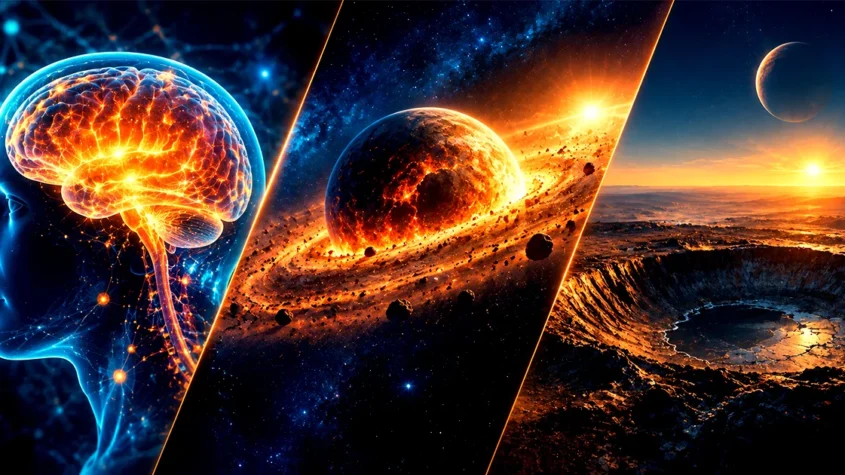
Science news moves fast enough that genuinely significant findings can slip by in a single news cycle. The past couple of weeks have delivered a handful of results worth pausing on — not because they’re flashy, but because a few of them quietly overturn assumptions most of us have carried around for years. Here’s what’s actually held up to scrutiny recently.
Your brain might not be one organ — it might be two
Here’s the kind of finding that sounds almost too strange to be real: Stanford researchers reported on September 21 that the human brain develops from two distinct cellular systems, suggesting that evolution effectively fused together two separate ancient nervous systems into what we now think of as a single organ. This isn’t a minor technical reclassification — it’s a genuinely significant challenge to how neuroscience has long understood brain development and structure.
The practical implications aren’t fully worked out yet, and it’s worth being honest about that rather than overselling a brand-new finding. But research like this tends to ripple outward over time, reshaping how scientists think about everything from developmental disorders to how different brain regions evolved to specialize in different functions. It’s the kind of foundational discovery that takes years to fully digest, but is worth knowing about now rather than only once the downstream implications are settled.
The calcium and vitamin D supplement you’re taking might not be doing much
This one has genuinely practical relevance for a lot of people. A sweeping review published around September 20, covering more than 153,000 adults, found that calcium and vitamin D supplements — taken alone or together — do little to prevent bone fractures. Given how widely these supplements are taken specifically for bone health, that’s a meaningful finding worth knowing if you’re one of the millions of people taking them for that exact reason.
Worth being precise about what this does and doesn’t mean: it’s not necessarily an argument to stop taking vitamin D or calcium altogether, especially if you have a specific deficiency your doctor has flagged — those are different medical situations with different evidence bases. It’s specifically a challenge to the common assumption that these supplements meaningfully reduce fracture risk in the general population. If bone health is your primary reason for taking them, this is worth a conversation with your doctor about whether the evidence actually supports what you’re taking them for.
A dinosaur-era fossil is rewriting bird evolution
Paleontologists reported in early September that a feather discovered inside 66-million-year-old fossilized dinosaur droppings may help explain a genuinely puzzling question: why modern birds survived the asteroid impact that wiped out most other dinosaur lineages, while so many close relatives didn’t. The extinct bird the feather came from had more primitive characteristics than modern birds, offering researchers a rare, direct physical clue from right around the extinction event itself, rather than working backward from fossils that predate or postdate the actual catastrophe.
Separately, and on a completely different branch of the dinosaur family tree, a newly identified 240-million-year-old animal from Tanzania — named Dinodontosaurus isiyavamanda — is forcing paleontologists to rethink the early dinosaur timeline. It belongs to a group previously known only from other regions, meaning its discovery in Tanzania extends both the geographic range and the timeline of understanding for this particular branch of early reptile evolution.
A crater found by accident, while someone was planning a camping trip
Sometimes the best discoveries happen sideways. An amateur astronomer, searching satellite maps on September 22 simply to scout a camping spot in Quebec, accidentally spotted what turned out to be a massive ancient impact crater. Scientists later visited the site and found shatter cones — distinctive rock formations that only form under the extreme pressure of a genuine impact event — confirming the discovery wasn’t just an unusual geological formation, but an actual, previously unrecorded impact site.
It’s a genuinely nice reminder that professional science doesn’t have a monopoly on discovery — publicly available satellite imagery, combined with someone simply looking closely at something unrelated to their original purpose, is still a real way that new findings get made.
The youngest planet ever confirmed
Astronomers confirmed in mid-September a Jupiter-sized planet less than a million years old — named Elias 2-24 b — making it the youngest known planet ever directly confirmed. In astronomical terms, a million years is essentially a snapshot of a planet still in the process of forming, giving researchers a genuinely rare, close-up look at planetary formation actually happening, rather than reconstructing the process after the fact from older, fully-formed planetary systems.
Why any of this is worth actually paying attention to?
It’s easy to treat a steady stream of “scientists discover X” headlines as background noise — interesting for a moment, then forgotten. But a few threads running through just this recent stretch are worth sitting with. The brain and supplement findings both challenge assumptions that shaped real decisions — how neuroscience approaches brain development, and what millions of people take every morning for bone health. The dinosaur and crater findings are reminders that Earth’s deep history is still being actively rewritten, not a settled story we’ve already fully mapped out. And the youngest-planet discovery is a genuine glimpse at cosmic processes usually only understood indirectly.
None of these findings are final words on their respective topics — that’s simply how science works, with each result opening up more specific questions rather than closing a subject entirely. But taken together, they’re a useful snapshot of just how much genuinely foundational work is still actively happening across completely different fields, all within the same few weeks.
Scientific understanding evolves as more research is published and results are replicated. These findings reflect the most recent reporting at the time of writing.




India’s Hidden Obesity Crisis: Why “Looking Healthy” Doesn’t Actually Mean You Are
Here’s an uncomfortable fact that most standard health checkups don’t catch: y…
Why 95% of Small Business AI Projects Fail And What the Other 5% Do Differently
Most small business AI projects fail because of problem misalignment — the AI is …