

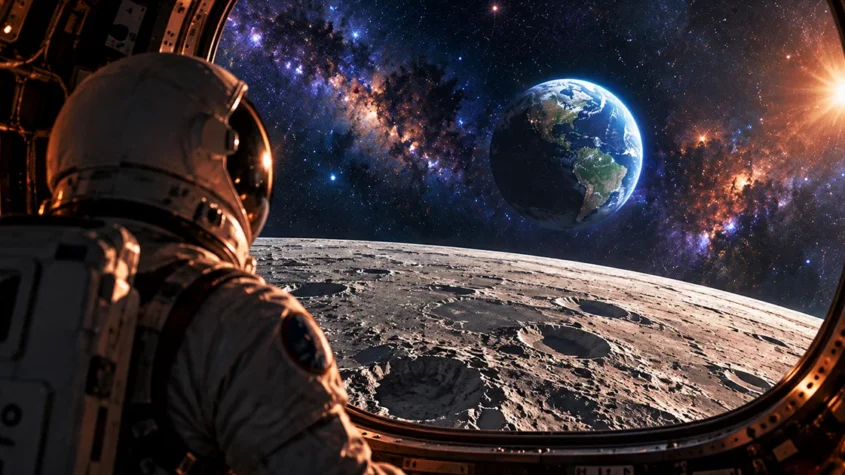
Some years in science feel incremental. 2026 hasn’t been one of them. The return of a human mission to deep space after nearly half a century, and the new insights our telescopes are revealing about the origins of planets, are significant milestones in themselves. Furthermore, a mysterious object in orbit has surprised scientists, making this year one of the most exciting for the world of space and science. Here’s what’s actually happened, without the jargon.
Humans went around the Moon again — for the first time since 1972
This is the big one. NASA’s Artemis II mission sent four astronauts around the Moon aboard the Orion spacecraft launched by the Space Launch System rocket — marking the first crewed mission beyond low Earth orbit since Apollo 17 in 1972. The roughly ten-day mission wasn’t just a nostalgia trip; it was a real test of whether Orion can keep a crew safe on long-duration missions beyond Earth’s protective magnetic field, testing navigation, communication, and life-support systems that future missions will depend on. The crew returned safely in the Pacific Ocean on April 10, 2026.
NASA didn’t stop there. By June, the agency had already unveiled the crew for Artemis III — the mission intended to actually land astronauts on the Moon again, this time testing new lunar landers rather than just flying past.
It hasn’t all gone smoothly across the industry, though. Blue Origin had a rocket explode during a test at Cape Canaveral in late May, a reminder that even with multiple companies now racing toward the Moon and beyond, this is still genuinely difficult, failure-prone engineering.
Planets that shouldn’t exist, according to what we thought we knew
Cotton Candy Planets and Changing Theories
Beyond our solar system, astronomers have spotted two strange exoplanets with densities comparable to cotton candy. This isn’t an exaggeration—these planets are so puffed up that their recorded densities are the lowest ever measured, setting a brand-new record.
Rethinking How Planets Form
The discovery is forcing scientists to revisit traditional planet formation theories. Classic models assumed a massive planet couldn’t be this light at the same time. Powered by a mix of established and new telescopes, exoplanet research is hitting a major turning point, with game-changing discoveries rolling in faster than ever.
A 60-million-star portrait of our own galaxy
Closer to home — or at least, closer in a relative sense — the European Space Agency’s Euclid telescope captured an image containing more than 60 million stars in the crowded heart of the Milky Way. Beyond being a striking image in its own right, this kind of deep imaging matters because instruments like Euclid, alongside NASA’s upcoming Nancy Grace Roman Space Telescope, are expected to massively expand how many exoplanets we know about — potentially pushing the current count from around 6,000 confirmed planets to well over 100,000 in the coming years, simply by being able to see faint, distant signals that older telescopes couldn’t pick up.
Euclid’s broader survey work has also fed into new findings about how supermassive black holes grow to such enormous sizes, with researchers using the telescope’s data to show galaxy collisions play a direct role in feeding them.
Something odd happened in orbit, and nobody’s fully explained it
In late June, a genuinely strange story broke: a mysterious object was detected after apparently separating from China’s reusable Shenlong spacecraft during an orbital mission. The event, which took place around June 22, 2026, sparked real concern in the space community about what the object actually is and whether it’s connected to secretive military activity in orbit. It’s a useful reminder that space isn’t just a science story anymore — it’s increasingly a geopolitical one too, with reusable spaceplane technology sitting at an uncomfortable intersection of scientific research and strategic competition between major powers.
The awards that quietly mark what mattered
If you want a shortcut for which scientific work the field itself considers the most significant, the major science prizes handed out through the year are a decent guide. The 2026 Shaw Prize in Astronomy went to Ken’ichi Nomoto and Stanford Woosley for their work on stellar explosions and how heavy elements are formed and scattered through the universe — essentially, the physics behind where the atoms that make up planets, and us, actually come from. Days later, the Gruber Cosmology Prize recognized Nomoto and Woosley again, alongside Alexei Filippenko, specifically for decades of supernova research. Kavli Prize winners in astrophysics were also announced in June, rounding out a year where a lot of recognition converged on the physics of exploding stars and how they shape the cosmos over billions of years.
Why any of this is worth knowing?
It’s easy to treat space and science headlines as background noise — interesting for a day, then forgotten. But a few of these threads genuinely connect to things that matter more directly: telescope technology that finds more exoplanets is the same technology that improves our ability to detect potentially hazardous asteroids closer to home. Supernova research explains fundamental questions about where the material world came from. And the growing overlap between space exploration and military strategy, visible in that Shenlong incident, is likely to keep shaping how nations invest in orbital technology going forward, well beyond pure science funding.
2026 isn’t over, and if the first eight months are any indication — a lunar flyby, record-breaking exoplanets, a 60-million-star portrait of our galaxy, and a genuine orbital mystery — there’s a reasonable chance the rest of the year adds a few more entries to this list before it’s done.





How Small Businesses Are Actually Using AI in 2026
Ask five different sources what percentage of small businesses use AI in 2026, and youR…

How to Document a Business Process in 90 Minutes (Before You Automate Anything)
You can reduce your headache by documenting a business process. It is simple to …