

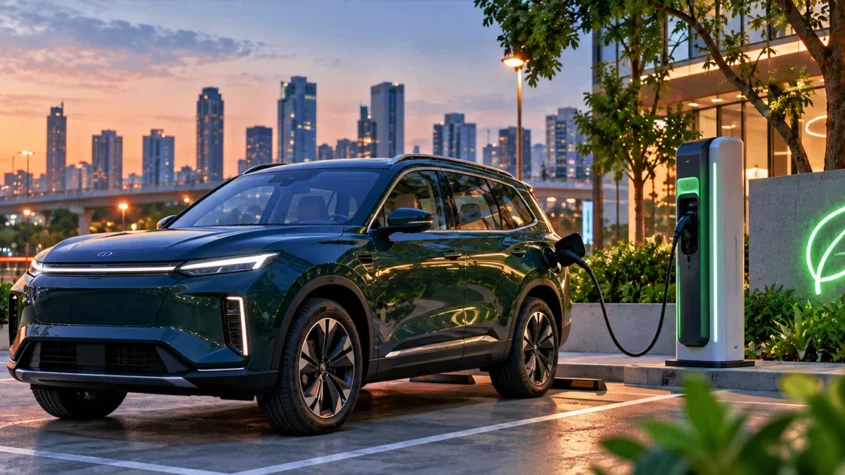
India’s EV market has quietly stopped being a niche experiment. Sales jumped 75% year-on-year in 2025 to around 165,000 units, according to the IEA’s Global EV Outlook 2026, pushing electric cars to nearly 4% of total car sales — and the momentum has only picked up since. Autopunditz reported 20,616 electric cars sold in February 2026 alone, a 25.3% jump over the previous month. If you’ve been on the fence about going electric, 2026 is genuinely shaping up to be the most competitive year yet for actually doing it.
What’s already on sale, and worth cross-shopping?
Several genuinely solid options are already available in showrooms rather than still being “expected.” Maruti’s first electric car, the e Vitara, launched in February 2026, priced between ₹15.99 lakh and ₹20.01 lakh depending on trim, with a choice of 49kWh or 61kWh battery packs delivering a claimed range of 440 to 543 km. For a first-generation EV from India’s largest carmaker, that’s a strong opening bid, and it puts real pressure on the segment’s existing players like the Tata Harrier EV and Hyundai Creta Electric.
On the more affordable end, the Tata Tiago EV remains India’s cheapest electric car at around ₹6.99 lakh, with a claimed range near 285 km — solid for city driving and short commutes, though not something you’d want for frequent long highway runs. In the mid-size SUV space, the Tata Sierra EV, Mahindra BE 6, and Kia Carens Clavis EV round out what’s become a genuinely crowded and competitive category — currently the single most contested segment in India’s EV market.
What’s arriving later this year?
The back half of 2026 has a real wave of launches worth waiting for if your current car still has some life left in it. MG’s seven-seater electric SUV, built on the company’s new ADAPT platform, launched August 26, 2026, with pre-orders already open and a claimed range above 500 km — a genuine option for larger families who assumed EVs weren’t practical for them yet.
Volvo’s EX90, a large three-row luxury electric SUV loaded with the brand’s latest safety tech, is expected around September 2026 at a steep ₹1.20 crore — squarely a premium, not a mass-market, choice. On the more accessible end, Hyundai’s Inster is expected to land around the Diwali festive season at roughly ₹11-13 lakh, positioned as a compact, characterful city EV aimed at exactly the buyers who’d otherwise default to a Tiago EV or Punch EV. VinFast’s VF3 is separately expected to undercut nearly everything else on this list, with pricing estimated between ₹8-10 lakh — and the company’s Battery-as-a-Service subscription model could push the effective upfront cost even lower for buyers willing to pay separately for battery access over time.
Why price gap with petrol cars keeps shrinking?
Two structural factors are doing a lot of quiet work here. GST on electric vehicles sits at just 5%, compared to 18-40% on equivalent petrol and diesel cars under the revised tax slabs — a real, direct reduction in upfront cost that petrol cars simply don’t get. Running costs favor EVs even more heavily day to day: typically ₹1-1.5 per kilometer for an EV versus ₹6-8 per kilometer for a comparable petrol car, based on current electricity and fuel pricing. For anyone doing meaningful daily mileage, that gap compounds fast — a car driven 15,000 km a year could be saving somewhere in the range of ₹75,000-100,000 annually just on running costs alone, before factoring in EVs’ generally lower maintenance needs (no oil changes, fewer moving parts).
This is part of why the government’s NITI Aayog target — 30% EV penetration by 2030, up from around 8.5% today — doesn’t look as far-fetched as it might have a couple of years ago. The economics are starting to genuinely work in the EV’s favor for a meaningful share of buyers, not just the environmentally motivated early adopters who dominated the category a few years back.
The one number you should treat with healthy skepticism
Here’s a genuinely useful piece of practical advice buried in most of the current EV coverage: manufacturer-claimed ARAI range figures typically run 20-30% above what you’ll actually get in real-world driving. A car claiming 500 km on paper is more realistically going to deliver somewhere around 350-400 km once you factor in air conditioning, highway speeds, and typical Indian traffic and road conditions. This isn’t unique to any one brand — it’s a pattern across the industry, tied to how the official testing cycle is structured versus how people actually drive.
The practical implication: when comparing two EVs’ claimed ranges, don’t take the headline number at face value. If you’re cross-shopping a 400 km-claimed car against a 500 km-claimed one, the real-world gap between them is probably smaller than the marketing numbers suggest — and your actual usable range on either one is meaningfully below what’s printed on the spec sheet.
What to actually check before buying?
Battery warranty terms, not just the headline range. Most manufacturers offer 8-year battery warranties, but the exact coverage — full replacement versus prorated, capacity degradation thresholds — varies enough between brands that it’s worth reading the fine print rather than assuming they’re all equivalent.
Charging infrastructure near where you actually live and commute, not just at the dealership. India’s public charging network has expanded, but coverage is still uneven between cities and highways, so a car that looks great on paper can be genuinely inconvenient if your specific commute or planned road trips don’t have reliable charging along the way.
Real-world range for your specific use case, using the 20-30% ARAI discount as your working assumption rather than the sticker figure.
Segment fit over badge appeal. With the mid-size SUV space this crowded, two similarly priced EVs can have meaningfully different real-world range, charging speed, and service network quality — the kind of differences that matter far more day-to-day than styling or brand cachet.
The bottom line
2026 isn’t just “a good year to consider an EV” in the abstract — it’s the first year where genuinely competitive options exist across nearly every price bracket, from the sub-₹10-lakh VinFast VF3 to seven-seater family SUVs to full luxury three-row options. If you were waiting for the market to mature before committing, this is close to the year that argument stops holding up. The main thing left to get right is matching the specific model to your actual driving pattern, charging access, and budget — not just picking whichever name is generating the most headlines.





Janmashtami 2026: Inside the Grand ISKCON Celebrations Across India
Just past midnight, in temples stretching from Chennai’s East Coast Road to the anci…

How to Document a Business Process in 90 Minutes (Before You Automate Anything)
You can reduce your headache by documenting a business process. It is simple to …