


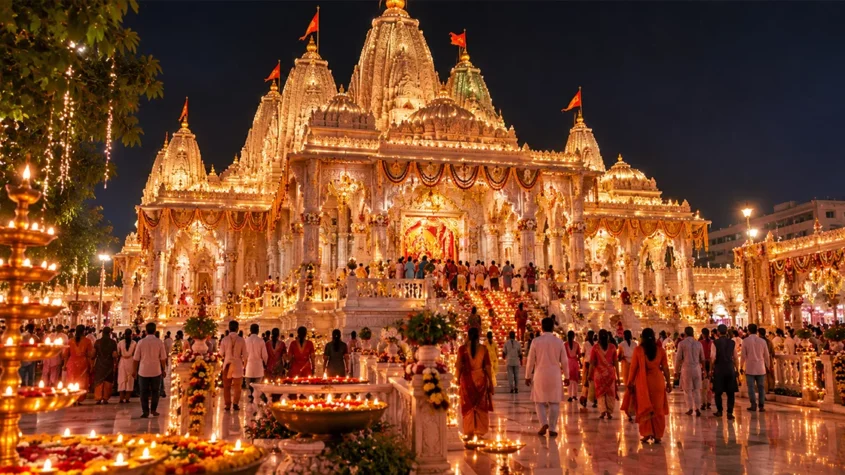
Just past midnight, in temples stretching from Chennai’s East Coast Road to the ancient lanes of Vrindavan, the same scene played out almost simultaneously — conch shells sounding, congregations breaking into kirtan, and priests performing the ceremonial bathing of the deity marking the exact moment Lord Krishna is believed to have been born. This year Janmashtami felt different, carrying a little extra weight too. By tradition, 5,253 years have been completed since Krishna’s birth in 2026. To celebrate the milestone, ISKCON temples across the country went all out with a full two-day festival rather than wrapping everything up in a single evening.
In this article, you will feel how the celebrations actually unfolded this year and why this festival still pulls in such enormous devotee turnout more than five decades after ISKCON was founded.
Why This Year’s Date Split Opinion?
If you noticed closely, some households celebrating on September 4 while ISKCON temples marked the occasion a day later, that’s not an inconsistency — it’s a genuine, longstanding difference in tradition.As most people know, Janmashtami is celebrated on the eighth day (Ashtami) of the dark fortnight in Bhadrapada.However, the exact date depends on whether a tradition focuses on when the tithi starts or when the Rohini nakshatra aligns at sunrise.Most households following the Smarta tradition observed the festival on September 4 this year, while ISKCON and the broader Vaishnava tradition marked it on September 5, timing their main midnight ceremony to when Rohini aligned at sunrise the following morning.
Both observances are considered correct within their respective traditions, which is part of why you’ll often see slightly different Janmashtami dates reported depending on which source or community you’re following.
What Actually Happens Inside an ISKCON Temple on Janmashtami?
The structure of ISKCON’s Janmashtami programming has become fairly consistent across its temples worldwide, even as the scale varies dramatically from city to city. Celebrations typically stretch across two days, opening with a Sandhya Arati, the evening worship ceremony, followed by an Adivas ceremony that formally marks the beginning of the festival period.
The next day is mostly reserved for the observance. It generally starts at the first light of the day with Mangala Arati, which is a sacred ritual at sunrise; after that, the discourse on the story of Srimad Bhagavatam is held, further Darshan Aratis are performed and finally the Guru Puja. As far as the fast is concerned, the devotees follow a complete one for entire day which is believed to result in liberation from evil and also in health and wealth in this world when one observes the Janmashtami festival sincerely according to Vaishnava text.
This being the main day, temples do Abhishekam Seva i.e. they consecrate the deity with the holy water ceremony. At the same time, they also hold a Kirtan Mela, which is a gathering of devotees singing devotional hymns or kirtans, a very common type of prayer. Such hymns continue to be sung from time to time throughout the day, often in the same form, sometimes with slight variations.
The real climax arrives close to midnight with the Maha Abhishekam, a grand ceremonial bathing performed amid continuous kirtan, followed immediately by the Maha Arati marking the precise moment of Krishna’s appearance.
Prasadam, the sanctified food offering, is distributed to devotees once the main ceremony concludes, often to a crowd that’s been waiting since well before sunset.
Chennai’s Celebration Reflected a Broader National Pattern
At ISKCON’s Chennai ECR temple, the two-day celebration followed this exact rhythm, drawing what temple organizers described as large numbers of devotees, families, youth, and members of the public across both days. The temple also streamed its ceremonies live for devotees unable to attend in person, a practice that’s become increasingly standard across ISKCON’s network in recent years and significantly widens the effective reach of a single physical event.
Chennai’s turnout was definitely not a one-of-a-kind phenomenon this year. ISKCON Bangalore even had a pretty grand program they called “Swagatam Krishna” to get people excited and engaged. It was a mix of old-school religious offerings with modern-day activities like a live campus music band and Divyam, a gathering of kids reciting Bhagavad Gita verses from the organizers claimed was the biggest such children’s recital in the city at one point. Bangalore also had the option of performing a Jhulan Seva, where one swings (the deity) while singing devotional songs for a good length of time on both festival days through their devotees.
This blend of deeply traditional ritual alongside newer, youth-focused programming has increasingly become the norm across ISKCON’s larger urban temples, reflecting a deliberate effort to keep the festival engaging for younger devotees without diluting its core religious observances.
Mathura and Vrindavan Remain the Emotional Center of It All
Although temple festivals in major cities such as Chennai and Bangalore attract a considerable crowd, there is a kind of worship that happens in Mathura and Vrindavan that is so big in scale that not even these big temples can compete with it.
Sitting just in the holy land where Lord Krishna spent his youthful days, being the birthplace of one of the most revered figures in Hinduism and Krishna being the main subject of Vaishnava avatars; this place is naturally a very crowded one. The area in U.P, which hosts a very significant spiritual activity at midnight Janmotsav and this is considered by Vaishnavas to be the highest moment of devotion in the Hindu calendar. Every year, millions of worshippers from different parts of the country come here for this festival, which they call a holy celebration, and most probably, for them, it is the most spiritually enriching activity on the Hindu calendar.
Vrindavan’s Banke Bihari Temple and the ISKCON temple there both hold flower festivals alongside continuous kirtan sessions leading up to midnight, while Mathura’s Dwarkadhish Temple performs its own distinctive ceremony, bathing its black marble Krishna idol, known locally as Dwarkanath, in holy water and panchamrit before cradling it in a ceremonial palana. The precise midnight window when these ceremonies peak, known as Nishita Kaal, typically lasts under an hour, and missing it means waiting a full year for the next opportunity — which is part of why devotees in Braj are known to pack temple courtyards and surrounding lanes well before midnight even arrives.
Why This Festival Keeps Growing Rather Than Fading?
Janmashtami’s popularity reveals much about religious festivals in India that are still managing a successful transformation without compromising the traditional core. It has been very significant for remote participants to be able to join a midnight ceremony in a temple anywhere in the world by means of live streaming. Previously, they were limited to a physical location which restricted accessibility. In fact, the temples have introduced some new facets for the younger crowd, such as youth-friendly programming, cultural festivals, and also community activities like annadana, or feeding food to the devotees who have come from far. Without displacing the fundamental pillars of fasting, kirtan and midnight worship that have remained pretty much the same for generations.
For ISKCON particularly, a group which has been extending its network globally over the time span starting from a humble home in the year 1966, Janmashtami is actually very similar to a time of a great convergence when all their temples are at their best the same sequence of rituals, roughly the same timing logic happening at the same time across several continents while the local temples still keep adding their unique size and flavors to the old shared tradition that’s going on for hundreds of years.
Frequently Asked Questions
Why did Janmashtami fall on different dates in 2026?
The date depends on which tradition a community follows. Most households following the Smarta tradition observed Janmashtami on September 4, while ISKCON and most Vaishnava temples observed it on September 5, timing their main ceremony to when the Rohini nakshatra aligned at sunrise.
What rituals are performed during ISKCON’s Janmashtami celebrations?
ISKCON’s celebrations typically include Sandhya Arati, an Adivas ceremony, Mangala Arati, a Srimad Bhagavatam discourse, Abhishekam Seva, congregational kirtan, and a midnight Maha Abhishekam followed by Maha Arati, concluding with prasadam distribution to devotees.
Why is Janmashtami 2026 considered especially significant?
Janmashtami 2026 marks the 5,253rd anniversary of Lord Krishna’s birth according to Hindu tradition, a milestone that added extra significance to this year’s celebrations across temples in India and worldwide.
Where are the biggest Janmashtami celebrations held in India?
Mathura and Vrindavan, widely regarded as Krishna’s birthplace, see the largest gatherings, with millions of devotees converging for the midnight Janmotsav at temples including Vrindavan’s Banke Bihari Temple and Mathura’s Dwarkadhish Temple.
Can devotees watch ISKCON Janmashtami celebrations online?
Yes, many ISKCON temples, including those in Chennai and Bangalore, livestreamed their Janmashtami ceremonies on their official YouTube channels for devotees unable to attend the temple in person.