

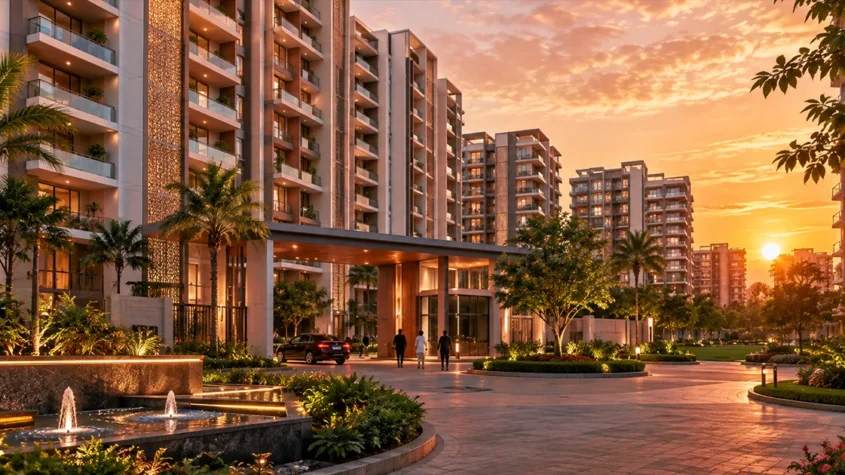
Here’s a genuinely strange thing happening in India’s housing market right now: fewer homes are actually being sold, and prices keep going up anyway. That sounds like it shouldn’t be possible — normally when demand softens, prices follow. But 2026’s numbers tell a more specific story than a simple slowdown, and understanding it matters whether you’re buying, selling, or just trying to figure out what your own home might be worth.
The headline numbers, and the contradiction hiding in them
Knight Frank’s data shows 84,827 homes were sold across India’s major cities in the first quarter of 2026 — a 4% year-on-year decline. Mumbai sales fell 7%, while both the Delhi NCR region and Pune dropped 11%. New launches fell too, down 2% year-on-year, and for the 14th consecutive quarter, developers launched more homes than buyers actually absorbed — the widest gap between the two since early 2023. Knight Frank has started calling this a “phase of consolidation” rather than a boom.
And yet, prices kept climbing regardless. The Reserve Bank of India’s own House Price Index recorded a 4.2% increase nationally in the January-March quarter, driven partly by strong demand in cities like Nagpur and Jaipur. JLL’s separate tracking showed even sharper city-level growth — Bengaluru, Chennai, Delhi NCR, and Kolkata all posted more than 12% year-on-year price growth, while Ghaziabad led the pack at 13% and Greater Noida followed at 11%.
Falling sales volumes and rising prices at the same time isn’t a contradiction once you look at what’s actually being sold.
It’s not a slowdown — it’s a shift upmarket
The real story is premiumization, and the data on this point is remarkably consistent across nearly every major research firm covering the sector. JLL found that homes priced above ₹1 crore grew 6% year-on-year even as the overall market contracted, and now make up 63% of all residential sales — up sharply from 53% just a year earlier. A separate industry report put that figure even higher, citing homes above ₹1 crore accounting for 71% of total sales, up from 59% the year before — a genuinely steep swing in a single year, however you measure it.
Zoom in further and the pattern gets sharper still. Properties priced above ₹1 crore specifically saw a 30% year-on-year sales increase in Q1 2026, according to JLL’s Residential Dynamics report, with the ₹1.5-3 crore segment growing an even more striking 67%. Meanwhile, the sub-₹1 crore segment — the more affordable end of the market that most first-time buyers actually shop in — contracted 24% year-on-year over the same period.
At the very top of the market, luxury real estate (homes priced ₹4 crore and above) has been an outright bright spot: sales in that bracket rose nearly 28% year-on-year across India’s top seven cities in 2025, with NRIs and high-net-worth individuals cited as major contributors — helped along, several analysts note, by rupee depreciation making Indian property relatively more attractive to overseas buyers.
The average ticket size across the market has climbed to roughly ₹1.47 crore, according to the India Housing Report 2026 by CRE Matrix and NAR-India — a figure that only makes sense once you understand the market isn’t shrinking uniformly, it’s simply moving toward buyers who can spend more.
Why is this happening?
Part of the explanation is straightforward: rising incomes among a specific segment of the population, and a well-documented buyer preference shift toward larger, better-located, higher-quality homes rather than settling for whatever’s cheapest and nearby. But there’s a less flattering read on the same data too. Speaking to Reuters in March 2026, Avneesh Sood of the Delhi-based Eros Group noted that home prices in major cities are rising faster than incomes generally, which is “forcing a larger proportion of the population to remain in the rental pool for much longer periods.” In other words, the premiumization story and the affordability story are really the same story, viewed from two different income brackets.
Supply-side dynamics reinforce this. Developers, chasing higher margins, have increasingly concentrated new launches in the premium and luxury segments, which is part of why unsold inventory nationally has climbed to around 1.8 billion square feet as of June 2026 — equivalent to roughly 1.9 years of trailing sales at the current pace. That inventory is disproportionately sitting in exactly the segments buyers are pulling back from, which is a genuinely uncomfortable position for developers focused on affordable and mid-market housing, even as their premium counterparts thrive.
What does this actually mean if you’re house-hunting?
If you’re shopping in the sub-₹1 crore bracket, the current market may actually favor you more than the headline growth numbers suggest. With developers eager to move slower-selling inventory in this segment, Knight Frank notes buyers here can expect more competitive pricing, negotiating room, and increasingly generous subvention schemes and freebies aimed specifically at converting hesitant buyers.
If you’re shopping above ₹1 crore, the data supports the opposite expectation — continued price appreciation with little sign of slowing, given how much demand has concentrated in this bracket. Waiting for a meaningful price correction in the premium segment doesn’t currently look like a strategy the data supports.
One factor working in buyers’ favor across the board: the RBI kept its repo rate unchanged through the first half of 2026, which has helped keep home loan costs relatively stable even as property prices themselves have climbed — a genuinely useful cushion for anyone financing a purchase right now rather than paying outright.
The bigger picture
Longer-term, most major research houses remain broadly optimistic about the sector — India’s real estate market is projected to surpass $1 trillion in value by 2030, with growth increasingly tied to infrastructure expansion (metro extensions, new expressways, projects like the Dwarka Expressway and Jewar Airport near Delhi) opening up entirely new micro-markets that didn’t exist as viable residential options a few years ago. ICRA projects new launches across the top seven cities to grow 6-9% in the current financial year alone, suggesting developers still see meaningful room to build, even in a market that’s clearly become more selective about what actually sells.
The honest summary for 2026: this isn’t a housing market cooling off. It’s a housing market getting pickier, in a way that rewards buyers in the affordable segment with real negotiating leverage, while continuing to push premium and luxury pricing higher with little resistance in sight.





OpenAI Says 10,000 AI Agents Made a Breakthrough on the Navier–Stokes Problem
Some mathematical problems are difficult enough to consume entire careers. The Navier–Stok…

Why 95% of Small Business AI Projects Fail And What the Other 5% Do Differently
Most small business AI projects fail because of problem misalignment — the AI is …