

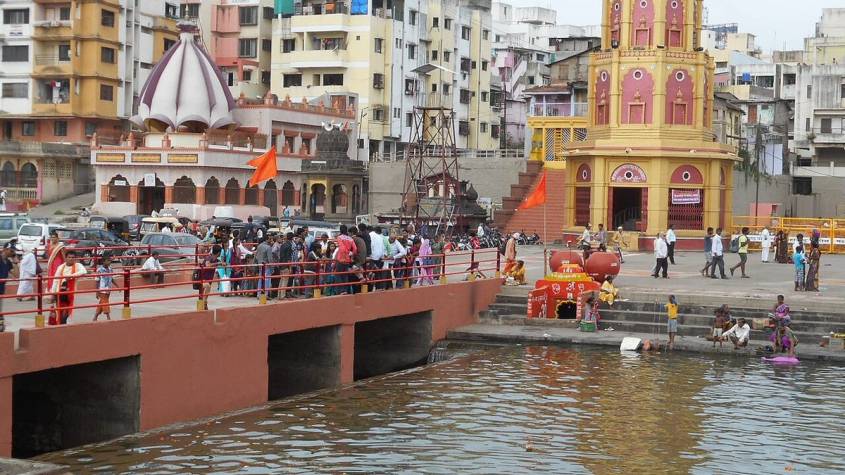
The Nashik Kumbh Mela 2027, officially the Nashik-Trimbakeshwar Simhastha Kumbh Mela, has already begun. The flags went up at Ramkund in Nashik and at Kushavarta in Trimbakeshwar at 12:02 pm on Saturday, 31 October 2026. The big bathing days come later: the three Amrit Snans fall on 2 August, 31 August and 11-12 September 2027.
Those dates come from the official calendar of the Nashik-Trimbakeshwar Kumbh Mela Authority (Simhastha Kumbh Mela 2027 snan calendar, Government of Maharashtra). Chief Minister Devendra Fadnavis announced them on 1 June 2025 after meeting the 13 akhadas (Times of India).
Nashik Kumbh Mela 2027 dates
The Simhastha runs from 31 October 2026 to 24 July 2028. The main mela period, when crowds peak, is 15 June to 30 September 2027.
| Event | Date | Where |
|---|---|---|
| Dhwajarohan (flag hoisting), start of the Simhastha | Saturday, 31 October 2026, 12:02 pm (held) | Ramkund, Nashik and Kushavarta, Trimbakeshwar |
| Main mela period begins | Tuesday, 15 June 2027 | Nashik and Trimbakeshwar |
| Nagar Pradakshina (procession, not a snan) | Thursday, 29 July 2027 | Nashik |
| First Amrit Snan | Monday, 2 August 2027 | Both sites |
| Second Amrit Snan | Tuesday, 31 August 2027 | Both sites |
| Third Amrit Snan (Vaishnav akhadas) | Saturday, 11 September 2027 | Ramtirth (Ramkund), Nashik |
| Third Amrit Snan (Shaiva akhadas) | Sunday, 12 September 2027 | Kushavarta Tirth, Trimbakeshwar |
| Dhwajavatarana (flag lowering), close | Monday, 24 July 2028, 3:36 pm | Official close of the Simhastha |
The authority lists every Amrit Snan as “all day”. Bathing hours, the akhada order and the traffic plan are not yet published, so treat any exact snan timing you see online as unofficial.
Is it called Shahi Snan or Amrit Snan?
Both names mean the same bathing days. The Maharashtra government now uses “Amrit Snan” (also spelt Amrut Snan), the term that came into official use at the 2025 Prayagraj Mahakumbh; older reports call them Shahi Snans.
Has the Nashik Kumbh already started?
Yes, formally. President Droupadi Murmu hoisted the Dharma Dhwaja on the 51-foot flagpole at Ramkund at 12:02 pm on 31 October 2026, while the Chief Minister raised the flag at Kushavarta (All India Radio News; Times of India).
Why the Nashik Kumbh happens: Jupiter in Leo
The Kumbh at Nashik and Ujjain is called Simhastha because it is held while Jupiter (Brihaspati) is in Simha, the sign of Leo. Jupiter takes about twelve years to go round the zodiac, which is why the mela returns roughly every twelve years.
The authority’s own explainer puts it simply: the timing “is decided by the position of a planet in the sky”, not by the calendar (Simhastha: The Astrological Basis). Legend links the four Kumbh sites to drops of amrit from the Samudra Manthan. The last Simhastha here was in 2015, when an estimated 30 million people attended (Wikipedia). After this one, the next is not due until 2039.
Nashik (Ramkund) vs Trimbakeshwar: which one to visit?
The Nashik Kumbh Mela 2027 has two bathing centres on the Godavari, about 28 km apart by road. Pilgrims are usually advised to pick one and stay there on snan days.
- Ramkund (Ramtirth), Nashik: a bathing tank on the Godavari in Panchavati, linked with the Ramayana. The Vaishnav (Bairagi) akhadas bathe here. Nearby are the Kalaram Temple, Sita Gumpha and Tapovan, where the sadhus’ camp, the Sadhugram, is proposed. This side has more hotels.
- Kushavarta Tirth, Trimbakeshwar: a sacred kund beside the Trimbakeshwar Jyotirlinga temple, near the source of the Godavari on Brahmagiri. The Shaiva akhadas bathe here. It is a small town, so rooms are scarce.
The authority’s FAQ says the Nashik-Trimbakeshwar trip normally takes about an hour, but on mela days it can take several hours. If you want darshan at the Trimbakeshwar Jyotirlinga, go on a quieter day, not on an Amrit Snan.
Can you bathe on days other than the Amrit Snans?
Yes. The schedule also counts Ekadashi, Purnima, Amavasya and certain yoga days as parvani bathing days, and these are far less crowded (Kumbh authority FAQs). Families with children and older pilgrims should choose one of these.
How to reach Nashik for the Kumbh
Nashik is the gateway for both sites; you continue to Trimbakeshwar by road (How to Reach, official portal).
- By air: Nashik’s airport is at Ozar, about 20 km from the city centre, with limited flights. Mumbai and Pune are the nearest major airports.
- By rail: Nashik Road station, on the main line from Mumbai, is the main railhead. Deolali, Odha, Kherwadi and Kasbe Sukene are also nearby. During the mela, the train from Mumbai can be easier than driving.
- By road: highways connect Nashik with Mumbai, Pune, Gujarat, Dhule and Chhatrapati Sambhajinagar. The Mumbai road climbs a ghat section that gets heavy rain and mist in the monsoon.
On snan days, vehicles are kept away from the ghats; parking is planned on entry roads, with shuttles and a final stretch on foot. Detailed routes will be published closer to the mela.
Where to stay and practical tips
- Book months ahead. Rooms near Ramkund go first. Pick refundable bookings, since the traffic plan is not final yet.
- Arrive the day before an Amrit Snan, never on the morning itself.
- Watch for the tent city. The authority says a paid tent city is usually set up at large Kumbhs; look for its official announcement for this Simhastha.
- Avoid fake booking sites. The FAQ warns against calls or messages asking for money for passes, darshan or rooms.
- Pack for the monsoon. The Amrit Snans fall in Shravan and Bhadrapad, and the Godavari can rise within hours. Bathe only at listed ghats.
If you have travelled for a big bathing fair before, such as the Kartik Purnima dip at Pushkar or the lamp-lit ghats of Dev Deepawali in Varanasi, expect the Kumbh to be many times larger.
When is the next Kumbh Mela?
The next Kumbh bathing days are at Haridwar, not Nashik. The Haridwar Kumbh 2027 runs from January to April 2027, starting with a bath on 14 January (Makar Sankranti); the Nashik Kumbh Mela 2027 Amrit Snans follow in August and September.
Uttarakhand Chief Minister Pushkar Singh Dhami listed Amrit Snans at Haridwar on 6 March (Mahashivratri), 8 March (Phalgun Amavasya) and 14 April 2027 (Mesh Sankranti) (Indian Express). After Nashik comes the Ujjain Simhastha, planned for 27 March to 27 May 2028 on the Kshipra, with three Shahi Snans proposed between 9 April and 8 May; the individual dates are not yet notified (Times of India). Our Makar Sankranti 2027 guide covers the January festival, and the 2026-27 festival calendar helps you plan the rest of the year.
Frequently asked questions
When is the first Amrit Snan of the Nashik Kumbh Mela 2027?
Monday, 2 August 2027, at both Ramkund in Nashik and Kushavarta in Trimbakeshwar.
When does the Simhastha 2027 end?
The flags come down on 24 July 2028 at 3:36 pm, but the busiest weeks are June to September 2027.
Sources: Nashik-Trimbakeshwar Kumbh Mela Authority (Government of Maharashtra) snan calendar, FAQs and travel pages; All India Radio News; Times of India; Indian Express; Wikipedia. Dates and arrangements can change, so check the official portal before you travel.
Featured image: Prabirghose / Wikimedia Commons, CC BY-SA 4.0 (resized). View across the Godavari at Ramkund, Nashik, during the 2015 Kumbh; not a 2027 photo.
Vaikunta Ekadasi 2026: Date, Parana Time, Tirumala and Srirangam Guide
Vaikunta Ekadasi 2026 falls on Sunday, 20 December 2026. In New Delhi the Ekadashi tithi b…

Why 71% of Indian Homebuyers Are Now Choosing ₹1 Crore+ Homes in 2026
There’s a number floating around in property circles right now that genuinely stops people …