


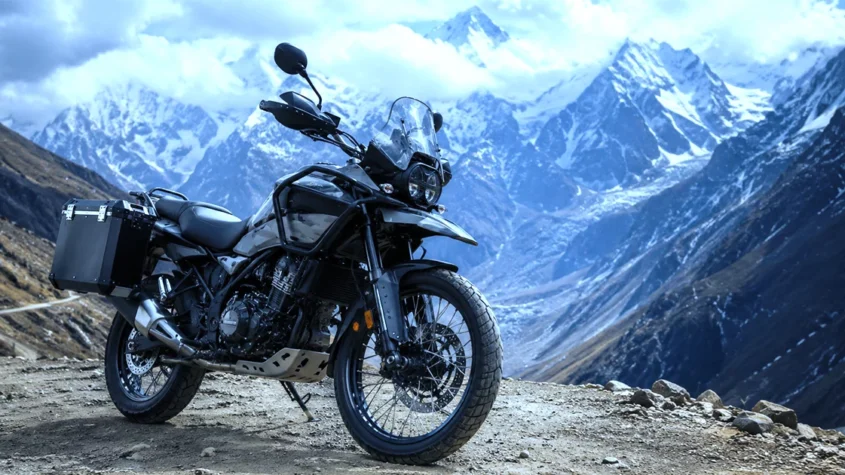
Royal Enfield kept every single detail about the Himalayan 440 under wraps, staying dead silent on specs and pricing until just days before the big launch. That secrecy just got a lot harder to maintain. Units of the motorcycle have already started turning up at dealership stockyards ahead of the September 4 launch, and the photos doing the rounds have quietly answered several questions fans have been debating since the first spy shots surfaced back in August.
Here’s everything those dealership sightings have actually confirmed, and how it stacks up against the bike it’s built alongside — the Scram 440.
The Launch Date Isn’t Random
Royal Enfield is set to officially unveil the Himalayan 440 on September 4, and the timing carries real significance — it lines up almost exactly with the tenth anniversary of the original Himalayan 411, the bike that first put Royal Enfield on the map as a serious adventure motorcycle brand rather than just a retro cruiser company. The reveal is expected to happen at the Royal Enfield Himalayan Basecamp in Leh, Ladakh, a location that’s basically the spiritual home turf for this entire model line.
The Royal Enfield anniversary timing also explains a lot about why this bike exists in the first place. The Himalayan 411 was discontinued back in 2023, replaced by the more advanced, more expensive Himalayan 450. A lot of longtime fans weren’t thrilled about losing the simpler, more affordable original, and the 440 looks like Royal Enfield’s direct answer to that gap — bringing back an accessible, mechanically simpler adventure bike, just built on newer underpinnings.
What’s Actually Under the Hood?
Leaked engine details suggest the Himalayan 440 will grab its engine straight from the Scram 440. That means we’re looking at a 443cc, air-and-oil-cooled single-cylinder setup pushing out 25.4 hp and 34 Nm of torque. That’s a modest but real step up from the outgoing Himalayan 411’s 24.5 horsepower and 32Nm, largely credited to a slightly larger bore. The bigger practical change is the gearbox — the Himalayan 440 is expected to get a six-speed transmission, an upgrade over the 411’s five-speed unit, which should make a genuine difference in highway cruising comfort and overall refinement.
Royal Enfield doesn’t appear to be reinventing the mechanical formula here, and that seems entirely intentional. Since the Himalayan 411 and Scram 411 shared identical engines before, it tracks that the 440 platform would follow the same logic — keep the proven, reliable engine consistent across siblings, and differentiate the two bikes through their chassis, wheels, and riding character instead.
Where It Actually Differs From the Scram 440?
This is really the question everyone’s been asking since the Himalayan 440 was first confirmed to be in development — if it shares its engine with the Scram 440, what actually justifies it being a separate motorcycle rather than just a reskin?
The wheels appear to be the clearest answer. The Scram 440 runs a 19-inch front wheel paired with a 17-inch rear, a setup tuned more for road use than serious off-roading. Dealership photos of the Himalayan 440, by contrast, show what looks like a larger 21-inch front wheel with a wire-spoked rim and tubed tyre, much closer to the setup the original Himalayan 411 used. A bigger front wheel like that generally means better rollover capability on rocky or uneven terrain, which is exactly the kind of change you’d expect if Royal Enfield wants this bike to actually earn its “Himalayan” name rather than just borrow it. It’s still unclear whether a higher trim will offer cross-spoked rims with tubeless tyres, though that seems like a reasonable possibility given how common that setup has become on adventure bikes in this segment.
Suspension travel is expected to be longer too, which would reinforce the same off-road-focused positioning. Between the wheel size and the suspension setup, the emerging picture is a bike that looks similar to the Scram 440 on paper but is actually tuned for a noticeably different kind of riding.
The Instrument Cluster Is Getting a Big Downgrade — On Purpose
This is really the question everyone’s been asking since the Himalayan 440 was first confirmed to be in development — if it shares its engine with the Scram 440, what actually justifies it being a separate motorcycle rather than just a reskin?
The wheels appear to be the clearest answer. The Scram 440 runs a 19-inch front wheel paired with a 17-inch rear, a setup tuned more for road use than serious off-roading. Dealership photos of the Himalayan 440 tell a completely different story. They show a larger 21-inch front wheel with wire spokes and tubed tires—a setup much closer to the original Himalayan 411.
A bigger front wheel like that generally means better rollover capability on rocky or uneven terrain, which is exactly the kind of change you’d expect if Royal Enfield wants this bike to actually earn its “Himalayan” name rather than just borrow it. We still don’t know if higher trims will get cross-spoked wheels with tubeless tires. That said, it’s a pretty safe bet considering almost every major adventure bike in this class offers them now.
Suspension travel is expected to be longer too, which would reinforce the same off-road-focused positioning. Looking at the wheel sizes and suspension setup, this isn’t just a copy-paste job. While it shares plenty with the Scram 440 on paper, it’s clearly tuned for a completely different style of riding.
What About Colours and Price?
One detail from those dealership leaks really stood out: a bright white rear fender. That has a lot of people convinced the Himalayan 440 is getting its own distinct color scheme instead of just recycling paint options from the Scram 440 or Himalayan 450. Colorways are always a massive deal for Royal Enfield marketing, so dropping a fresh palette makes total sense—and it’ll help the 440 feel like its own standalone model rather than just another repackaged trim.
On road pricing nothing is officially confirmed yet, but the consistent range being floated is roughly around ₹2.30 lakh to ₹2.60 lakh ex-showroom, with ₹2.50 lakh being the most common price quoted. That would put Himalayan 440 right between Scram 440 and Himalayan 450 on the price scale, the latter starting above ₹3 lakh, allowing Royal Enfield to have a completely different range for Himalayan 440, thereby avoiding a cannibalization of either of the existing models.
What This Means for Himalayan 411 Fans?
If there’s one reassuring takeaway from everything that’s emerged so far, it’s this — outside of the instrument cluster and the six-speed gearbox, the Himalayan 440 is shaping up to look and feel remarkably close to the beloved 411 it’s replacing. For a fanbase that was genuinely disappointed when the original got discontinued in favour of the pricier, more complex 450, a simpler, more affordable adventure bike that keeps most of what made the original special is likely to land well, even with the console downgrade some purists will grumble about.
With the official launch just days away at this point, the remaining questions — final pricing, full variant lineup, and the complete colour range — should all be answered directly rather than pieced together from dealership sightings much longer.
Frequently Asked Questions
When is the Royal Enfield Himalayan 440 launching?
The Himalayan 440 is set to officially launch on September 4, 2026, at the Royal Enfield Himalayan Basecamp in Leh, Ladakh, timed close to the tenth anniversary of the original Himalayan 411.
What engine does the Himalayan 440 use?
It’s expected to share the Scram 440’s 443cc air and oil-cooled single-cylinder engine, producing 25.4 horsepower and 34Nm of torque, paired with a six-speed gearbox.
How is the Himalayan 440 different from the Scram 440?
The main differences are expected to be a larger 21-inch front wheel with longer suspension travel for better off-road capability, along with a distinct colour lineup, while the engine and core chassis platform remain shared.
What is the expected price of the Royal Enfield Himalayan 440?
Based on pre-launch estimates, the Himalayan 440 is expected to be priced around ₹2.50 lakh ex-showroom, positioning it between the Scram 440 and the pricier Himalayan 450.
Does the Himalayan 440 have a tachometer?
Based on dealership sightings, the Himalayan 440 appears to use a simplified twin-pod instrument cluster without a tachometer, matching the setup used on the Scram 440, a change from the original Himalayan 411’s multi-dial cockpit.