

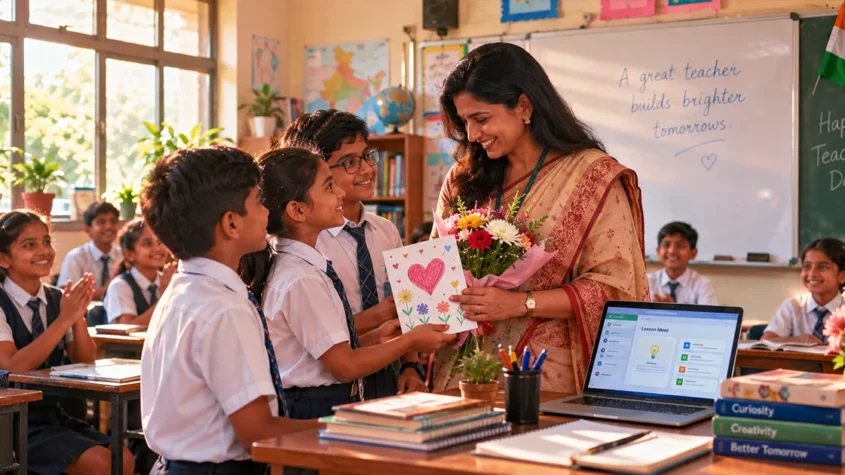
If you are not aware of why we celebrate Teachers’ Day in India, it commemorate the birth anniversary of Dr. Sarvepalli Radhakrishnan. On this occasion, President Droupadi Murmu will present the National Teachers’ Awards to 48 school teachers from across the country at Vigyan Bhawan in New Delhi.
For Indian education, the celebration comes at quite an unusual moment. AI has entered all fields of industries than teachers can’t step behind. More than 70% of Indian teachers are using AI tools for lessons and classroom tasks, by the Centre for Teacher Accreditation (CENTA). At the same time, AI literacy is set to become part of school education from Class 3 beginning with the 2026–27 academic year.
The Teachers’ Day story in India has had a comforting pattern for decades. Role-swap games in classrooms, carefully written notes, flowers for favourite teachers, and a President handing out National Teachers’ Awards in Delhi.
That hasn’t changed in 2026 — but teaching itself has.
This year’s Teachers’ Day arrives while technology is rapidly changing how teachers plan lessons, work with students and prepare children for a world where AI will increasingly be part of everyday life.
Why Is Teachers’ Day Celebrated on September 5?
The story behind the date is perhaps one of the most heartwarming origins of India’s national observances.
Dr. Sarvepalli Radhakrishnan, born on September 5, 1888, was a philosopher, scholar and India’s second President. After he became President in 1962, some of his students and friends wanted to celebrate his birthday.
Instead, Radhakrishnan suggested that September 5 should be observed as Teachers’ Day.
That simple idea resulted in a national celebration.
Every year since 1962, September 5 has been celebrated as Teachers’ Day, or Shikshak Diwas, in India. It is separate from World Teachers’ Day, which is observed internationally on October 5.
Radhakrishnan died on April 17, 1975, but his connection with education continues to shape how India celebrates teachers more than five decades later.
National Teachers’ Awards 2026
The National Teachers’ Awards are one of the country’s highest recognitions for school teachers, highlighting educators whose work has made a difference inside and beyond the classroom.
Awardees would be selected through a three-stage process at the district, state and national levels. Uttar Pradesh takes the top spot among all states this year, with three of its teachers being selected for the honor.
2026 list is a mirror to India’s very diverse system of education. The awardees hailed from various geographical locations across the country and were even teachers of such specialities as Eklavya Model Residential Schools and Sainik School Teachers.
Through their efforts, they have shown how the teacher community of the country has come up with different methods for learning enhancement in totally different classes.
Teachers’ Day Is Arriving During a Big Change in Indian Classrooms
What really sets this year’s Teachers’ Day apart isn’t the ceremony itself. It’s the larger change happening around it.
India has one of the world’s largest school systems, with millions of students and teachers spread across more than a million schools.
And AI is already finding its way into those classrooms.
According to CENTA’s 2025 survey, more than 70% of Indian teachers are using AI tools for lessons and classroom-related tasks. Among teachers with more than three years of experience, usage was around 75%.
Lesson planning is one of the most common uses.
That makes sense when you think about how much work happens before a teacher even walks into a classroom. Preparing lessons, finding examples, adjusting material for different students and creating classroom activities all take time.
AI can help with some of that work.
But that doesn’t mean the teacher becomes less important.
AI Is Changing Teachers’ Work, Not Removing the Teacher
This is worth understanding because conversations about “AI in classrooms” can quickly turn into a debate about whether technology will replace teachers.
That’s not really what is happening.
AI can help teachers prepare different versions of lessons, identify areas where students may be struggling and adjust learning material according to different ability levels.
In a classroom where one student understands a topic immediately and another needs more time, that kind of support can be useful.
The teacher still decides what students need to learn, how a subject should be taught and when technology should or shouldn’t be used.
There is another area where AI could be particularly useful in India: language.
India’s classrooms are multilingual. A child may speak one language at home while studying in another language at school. Better multilingual tools could help teachers explain difficult concepts in languages students understand more comfortably.
But AI also brings problems teachers have to deal with.
AI-generated information can be wrong. Student data needs protection. Schools also have to think about distraction, overdependence on technology and whether students are actually learning or simply asking a tool to do the work for them.
So the conversation has already moved beyond simply asking whether schools should use AI.
The harder question is how they should use it.
AI Literacy From Class 3 Changes the Conversation Again
Beginning with the 2026–27 academic year, AI literacy is expected to become part of Indian schooling from Class 3.
For younger students, this doesn’t mean sitting down and building complicated AI models.
The focus includes basic ideas around computational thinking, understanding data and using technology responsibly.
Several states, including Telangana, Karnataka, Kerala, Odisha and Maharashtra, have also started teacher-training initiatives focused on AI-enabled teaching.
That training is important because introducing AI into a curriculum is much easier on paper than making it work inside a real classroom.
And that’s where India faces another challenge.
Not Every Teacher Is Starting From the Same Place
The transition to AI isn’t happening equally everywhere.
Some teachers already use AI regularly and have access to good internet connections, devices and training. Others are working in schools where even basic digital infrastructure can be limited.
That creates a real gap between policy and implementation.
A teacher in a well-equipped urban school may have the freedom to experiment with AI-assisted lesson planning or personalised learning tools. A teacher somewhere else may be dealing with unreliable internet, limited devices or little formal training.
So making AI literacy part of the curriculum is only the first step.
Teachers also need practical training and support if the policy is going to work in classrooms across the country.
This is what makes Teachers’ Day 2026 particularly interesting.
India is celebrating some of its best teachers at the same time that the profession itself is being asked to adapt to one of the biggest technological changes in modern education.
How Can Students and Schools Celebrate Teachers’ Day Meaningfully?
Flowers, cards and school celebrations still have their place. There is nothing wrong with any of them.
But a meaningful Teachers’ Day doesn’t necessarily need to be complicated.
Students can think about one specific thing a teacher has done for them and say it directly. A short handwritten message explaining how a teacher helped you understand a difficult subject or gave you confidence at the right moment can mean more than a generic “Happy Teachers’ Day” message.
Schools can also use the occasion to think about what teachers themselves need.
If teachers are now expected to use new technology, understand AI, personalise learning and continue handling their normal classroom responsibilities, access to proper training matters.
Schools or local education groups that don’t yet have structured AI training could encourage practical learning sessions for teachers instead of treating technology as another responsibility they simply have to figure out on their own.
Students and parents can also read about this year’s National Teachers’ Award recipients. The 48 awardees come from different parts of the country and different types of schools, and their work offers examples of what successful teaching can look like in very different circumstances.
Teachers’ Day Still Comes Back to the Teacher
Technology may be changing the classroom quickly, but the basic reason India celebrates Teachers’ Day hasn’t really changed.
AI can prepare material. It can analyse data. It can help create a lesson plan or explain the same idea in several different ways.
But students rarely remember school because of the software they used.
They remember the teacher who noticed they were struggling. The teacher who explained something one more time when the rest of the class had already moved on. Or the teacher who gave them confidence when they didn’t have much of it themselves.
That human part of education is difficult to put into a curriculum.
And on Teachers’ Day 2026, while India prepares students and teachers for an increasingly AI-driven classroom, it may be worth remembering that part too.





Janmashtami 2026: Inside the Grand ISKCON Celebrations Across India
Just past midnight, in temples stretching from Chennai’s East Coast Road to the anci…

How to Document a Business Process in 90 Minutes (Before You Automate Anything)
You can reduce your headache by documenting a business process. It is simple to …