

Some mathematical problems are difficult enough to consume entire careers. The Navier–Stokes existence and smoothness problem is one of them.
It asks a deceptively simple question about the equations used to describe the motion of fluids: if you start with a smooth flow in three dimensions, will it remain smooth forever, or can the equations eventually develop a singularity where the mathematical description breaks down?
It has remained one of mathematics’ most famous open problems for decades.
Now OpenAI says a massive network of AI agents has produced a proof addressing part of that problem.
According to the company’s September 8, 2026 announcement, approximately 10,000 communicating AI agents worked for 88 hours before arriving at the result. A separate formal verification process reportedly continued for another 17 hours.
If the proof survives independent mathematical scrutiny, the technical achievement alone would be remarkable.
But almost immediately, another issue complicated the story: two mathematicians raised questions about whether unpublished human research may have contributed to the AI system’s work without proper attribution.
So this isn’t only a story about whether AI can solve extremely difficult mathematics.
It’s also becoming a story about what happens when human research and autonomous AI research begin to overlap.
What Is the Navier–Stokes Problem?
The Navier–Stokes equations describe how fluids move.
“Fluid” doesn’t only mean water. The equations are relevant to liquids and gases, making them important across areas such as aerodynamics, weather modelling, engineering and physics.
The problem is what happens under extreme mathematical conditions.
In three dimensions, mathematicians still want to know whether smooth starting conditions are guaranteed to produce smooth solutions indefinitely.
The alternative is the possibility of a singularity — a point where some quantity described by the equations becomes unbounded in finite time.
This question is one of the seven Millennium Prize Problems announced by the Clay Mathematics Institute in 2000. A correct solution to each problem carries a $1 million prize.
Only one of the original seven, the Poincaré Conjecture, had previously been resolved.
What OpenAI Says Its System Found
According to the material released around the announcement, OpenAI’s system approached the problem by constructing a scenario involving increasingly concentrated vortex behavior.
In broad terms, the claimed result concerns whether a fluid vortex can continue tightening and accelerating in a way that eventually produces singular behavior while certain overall quantities remain controlled.
The underlying mathematics is far more complicated than that description suggests.
And this distinction matters: an announcement of a proof is not automatically the same thing as a universally accepted solution.
For a problem of this magnitude, mathematicians will need time to examine the argument, reproduce its reasoning and determine whether every part of the proof holds.
That process can take months or considerably longer.
10,000 AI Agents Worked on the Problem
The scale of the AI system is one of the most unusual parts of the story.
This wasn’t described as a single chatbot receiving a difficult mathematics question and producing an answer.
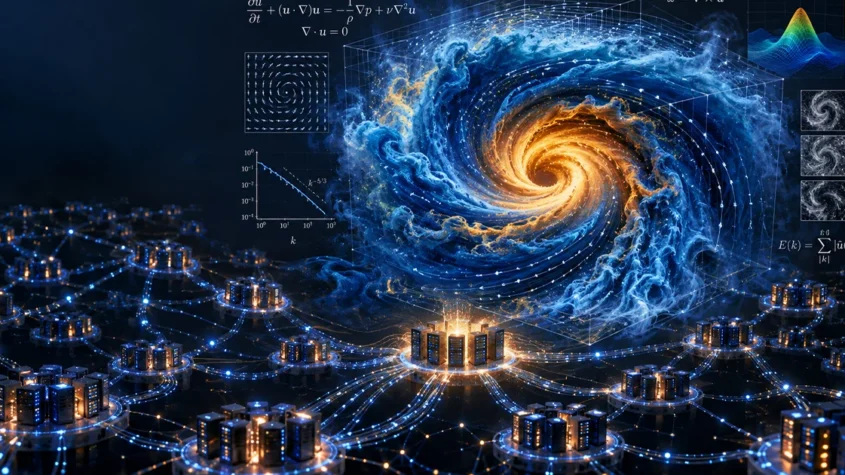
OpenAI reportedly organized approximately 10,000 AI agents into communicating groups, allowing different agents to work on parts of the research while exchanging results.
The source describes the run as beginning on September 5 and continuing for approximately 88 hours.
During that period, the agents reportedly generated around 2.7 million inter-agent communications and approximately 130 billion output tokens.
The computational cost was reportedly in the millions of dollars.
That scale changes the nature of what “AI doing mathematics” can mean.
Instead of one model assisting one mathematician with a proof, thousands of instances can potentially explore different approaches, reject unsuccessful paths, share useful findings and continue from the work of other agents.
The Proof Was Then Formally Checked
Finding a convincing mathematical argument is only one part of the process.
OpenAI reportedly followed the research phase with approximately 17 additional hours of formal verification using Lean.
Lean is a theorem prover that allows mathematical arguments to be represented in a form that can be checked logically by a computer.
That doesn’t eliminate the need for independent review.
It does, however, provide a different level of checking from simply asking another language model whether the proof looks correct.
OpenAI has reportedly released the proof and its Lean formalization publicly rather than pursuing the $1 million Millennium Prize.
The larger goal appears to be demonstrating what highly coordinated AI systems may be capable of in scientific and mathematical research.
Then the Attribution Dispute Started
The technical achievement isn’t the only reason the announcement attracted attention.
Mathematicians Tristan Buckmaster and Levent Alpöge had reportedly been working for around a year on a sequence of difficult problems related to fluid dynamics.
Their work included the incompressible porous-medium equation, the Boussinesq system and three-dimensional incompressible Euler equations.
According to the account in the source material, the researchers had made significant progress by August 2026 and had also used AI tools extensively during their work, including systems from OpenAI and Anthropic.
Their working material was reportedly used during Codex sessions.
That created a difficult question once OpenAI announced its own AI-generated mathematical result.
The mathematicians raised concerns that their unpublished research may have entered OpenAI’s systems and subsequently influenced work in a closely related area without appropriate attribution.
What Do We Actually Know About That?
This is where the story becomes much less clear.
The available information does not establish a simple chain showing that the AI system copied the mathematicians’ unpublished work and turned it into the announced result.
At the same time, the researchers’ concerns create a legitimate attribution question because their work reportedly interacted extensively with AI systems before publication.
OpenAI acknowledged that certain usage information may contribute to improving its systems, according to the source material, but the exact relationship between that data and this particular mathematical result remains disputed.
Until more evidence becomes available, it would be premature to describe the situation either as proven theft or as a completely resolved misunderstanding.
The uncertainty itself is important.
If autonomous AI systems increasingly participate in original scientific research, researchers and AI companies will need much clearer rules around unpublished work, training or usage data, attribution and authorship.
This Is Bigger Than One Mathematical Proof
Suppose the mathematical community eventually concludes that the proof is correct.
The most significant part of the story may not be that an AI system helped solve an extraordinarily difficult problem.
We’ve already seen AI becoming increasingly useful in mathematics, coding and scientific research.
What’s different here is the scale and organization of the process.
Thousands of agents were reportedly working simultaneously rather than a researcher simply asking one model for assistance.
Think of the difference between giving one mathematician an AI assistant and creating an entire temporary research organization made from AI agents.
One agent can explore one direction.
Another can test an alternative.
Others can check intermediate results, search existing literature, write code or communicate useful findings to the rest of the system.
At sufficient scale, the system starts to resemble a research team more than a conventional chatbot.
That may be the more consequential experiment.
Human Researchers Are Still Part of the Story
It’s tempting to frame developments like this as AI versus mathematicians.
The reality is already more complicated.
The human researchers involved in the attribution dispute were themselves reportedly using advanced AI tools as part of their work.
Meanwhile, OpenAI’s autonomous system exists within an enormous body of mathematics produced by humans over centuries.
The boundary between “human research” and “AI research” is therefore becoming increasingly difficult to draw.
Who deserves authorship when an AI system develops a proof?
What happens if the system’s reasoning was influenced by unpublished work supplied during another researcher’s AI sessions?
How much disclosure should AI companies provide about that relationship?
And if thousands of agents collectively produce a discovery, what exactly does authorship mean?
Those questions don’t disappear even if the Navier–Stokes proof turns out to be correct.
What Happens Next?
The first thing to watch is independent mathematical verification.
A claimed breakthrough involving a Millennium Prize Problem will receive extraordinary scrutiny. Researchers will examine the assumptions, intermediate steps, formalization and final argument before the result can be treated as established mathematics.
The second issue is attribution.
More information will be needed to understand exactly what happened between the researchers’ unpublished work and OpenAI’s autonomous research system.
And then there is the much larger question.
If thousands of coordinated AI agents can genuinely contribute to a problem that has resisted human mathematicians for decades, what happens when similar systems are pointed at other open problems in mathematics, physics, chemistry or biology?
We don’t have that answer yet.
For now, OpenAI has made an extraordinary claim.
Whether it becomes an extraordinary mathematical result depends on what happens when the rest of the mathematical community checks the work.





India’s 2026 Housing Market: Why Prices Keep Rising Even as Fewer Homes Are Selling
Here’s a genuinely strange thing happening in India’s housing market right now…

Why 95% of Small Business AI Projects Fail And What the Other 5% Do Differently
Most small business AI projects fail because of problem misalignment — the AI is …