
Most people who know Indian history have heard of Panipat. The first battle there in 1526 is how Babur entered the story — the ruler from Kabul who defeated Ibrahim Lodi and took Delhi. What fewer people know is that Panipat only gave Babur a city. What happened eleven months later at Khanwa decided whether the Mughals would actually stay.
The battle of khanwa was fought on March 16, 1527, near a village in present-day Rajasthan about forty kilometres west of Agra. It was a harder test than Panipat and, in some ways, a more important one.
Who Was the Battle of Khanwa Fought Between?
The battle of khanwa was fought between Babur and Rana Sanga — formally Maharana Sangram Singh of Mewar. Understanding why they ended up on opposite sides requires going back a little.
After Panipat, Babur’s commanders were exhausted and homesick. Many wanted to take their loot and return to Kabul. The heat, the unfamiliar conditions, and the scale of what Babur was attempting were not universally welcome.
Meanwhile, Rana Sanga had initially encouraged Babur to come into India, expecting him to weaken the Lodi Sultanate and then leave. When it became clear Babur planned to stay and rule, Sanga changed course. He assembled the largest military coalition seen in northern India at that time — Rajput chiefs from across Rajputana, Afghan nobles resentful of Babur’s presence, and regional rulers who did not want a new empire.
The battle of khanwa fought between these two sides was not just a military confrontation. It was a direct challenge to whether the Mughal Empire would survive past its first year.
Rana Sanga and the Size of the Coalition
By the time the battle of khanwa was fought between Babur’s forces and the Rajput coalition, Sanga had assembled an army of around 80,000 to 100,000 soldiers — war elephants, experienced Rajput cavalry, and chiefs from across the region.
Rana Sanga was not a figure to take lightly. He had fought well over a hundred battles. He had lost one eye, one arm was crippled, and he walked with a limp from old injuries. None of that had dimmed his reputation. He was the kind of leader soldiers followed without question.
Babur’s army was around 12,000 to 15,000 men. His commanders were demoralised. The mood in the Mughal camp was poor enough that Babur gave a speech forbidding his men from drinking wine and declaring this a holy war. He took the title Ghazi — one who fights for the faith — after what followed.
What Made babur vs rana sanga So Unequal on Paper
In the babur vs rana sanga confrontation, every conventional measure pointed to Sanga winning. Numbers, local knowledge, fresh troops, war elephants, and the psychological advantage of familiar ground — the Rajput side had all of these.
What Babur had was gunpowder artillery. Sanga’s coalition had no answer for it.
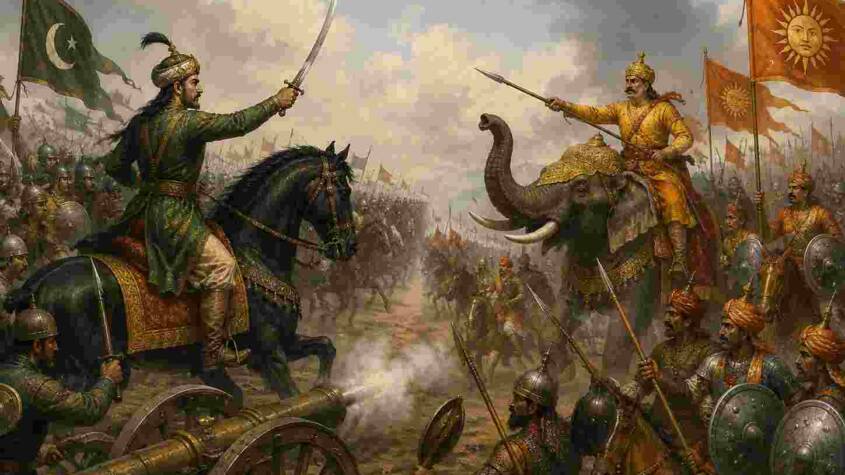
Babur positioned his cannon behind a line of chained carts, protecting his gun crews while they fired. On both flanks, he placed cavalry trained in the tulughma — a Central Asian encircling move where riders swing around both sides of the enemy simultaneously. Sanga’s forces advanced expecting a mass engagement where numbers would decide it. What they got was cannon fire into their front and cavalry hitting both flanks at the same time.
The Battle of Khanwa 1527: How It Unfolded
The battle of khanwa 1527 began in the morning of March 16.
As the Rajput forces advanced, Babur’s artillery fired. The sound of cannon terrified the war elephants immediately. Panicked elephants in a battle are a disaster — they do not hold formation. They turn and crash through their own infantry. Sanga’s front lines began breaking apart before they had properly made contact.
Key points from the battle of khanwa 1527:
- Artillery fire broke the Rajput advance and sent war elephants through their own infantry
- Flanking cavalry struck both sides of the coalition simultaneously
- Afghan chiefs within Sanga’s coalition defected mid-battle
- The Rajput formation collapsed under pressure from multiple directions at once
- Rana Sanga escaped but died the following year, reportedly poisoned by his own chiefs
By the afternoon of March 16, it was over.
Why This Battle Matters More Than Most Textbooks Suggest
The battle of khanwa is often presented as a footnote to Panipat — a secondary confirmation of what the first battle established. That framing understates what was actually at stake.
Panipat removed a weakened dynasty. The Delhi Sultanate under Ibrahim Lodi had already lost the loyalty of many of its own nobles before Babur arrived. Defeating it was significant but not a guarantee of anything beyond that.
Khanwa was different. Rana Sanga represented the most powerful independent military force in northern India — not a crumbling sultanate but an active, capable, and well-resourced opponent who chose to fight specifically because he wanted the Mughals gone. Defeating that coalition, decisively, on the open field, sent a message that no subsequent ruler in the region chose to test for years.
The political consequences followed quickly. Babur’s own troops, who had been uncertain about staying in India, had much less reason to leave after a victory of this scale. The title of Ghazi gave him religious legitimacy among Muslim nobles who had questioned his authority. And the Rajput confederacy, which Sanga had spent months building, never reassembled at that scale again.
Frequently Asked Questions
-
What was the battle of Khanwa and when did it take place?
The battle of khanwa was fought on March 16, 1527, near Khanwa village in present-day Rajasthan. It was a major confrontation between Babur and Rana Sanga’s Rajput coalition and is considered one of the most significant battles in early Mughal history. Babur’s victory secured the Mughal Empire’s position in northern India after Panipat.
-
Who was the battle of Khanwa fought between?
The battle of khanwa was fought between Babur — the founder of the Mughal Empire — and Rana Sanga, also known as Maharana Sangram Singh, who led a large coalition of Rajput chiefs, Afghan nobles, and regional rulers opposed to Mughal expansion. The battle of khanwa was fought between these two sides after Rana Sanga had initially encouraged Babur’s entry into India and then turned against him when it became clear Babur planned to stay.
-
Why did Babur win the babur vs rana sanga battle despite being outnumbered?
In the babur vs rana sanga confrontation, Babur’s army was smaller but had two decisive advantages: field artillery and the tulughma flanking tactic. His cannon fire panicked Rana Sanga’s war elephants, which turned back into their own infantry lines. His cavalry simultaneously attacked both flanks. The coalition — already not fully unified — collapsed under coordinated pressure from three directions at once.
-
What happened to Rana Sanga after the battle of Khanwa 1527?
Rana Sanga escaped the battlefield but never mounted another significant campaign. He died in 1528, within a year of the battle of khanwa 1527. Historical accounts suggest he was poisoned by his own chiefs, who had decided that continuing to follow him would only lead to further devastating defeats. His death effectively ended the Rajput challenge to Mughal authority for a generation.
-
How was the battle of Khanwa different from the first battle of Panipat?
Both were decisive Mughal victories, but they were decisive against different types of opposition. Panipat ended a weakened dynasty whose own nobles had largely abandoned it. Khanwa defeated the most powerful active military coalition in northern India, led by one of the most capable commanders of the era. The battle of khanwa was fought between Babur and a genuinely formidable opponent — which is precisely why historians consider it as important as Panipat, even if it receives less attention in popular history.