

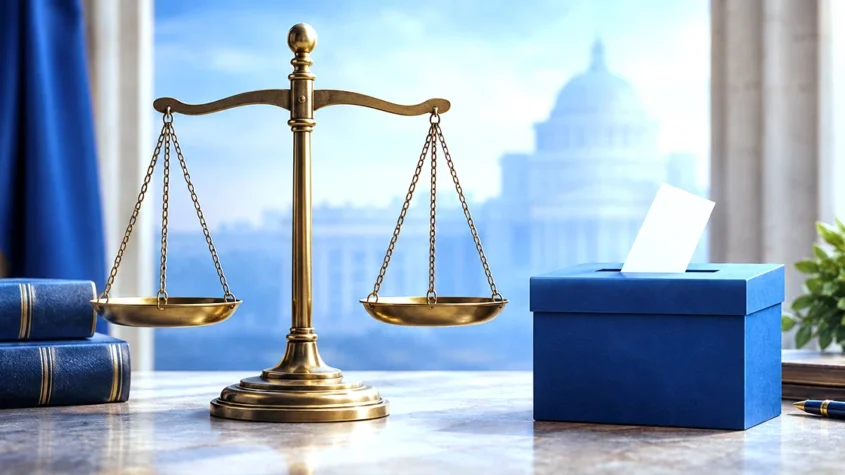
If we take aside the developments regarding SIR, or the West Bengal election campaign or talk about India’s 2026 election calendar (which is already quite busy), there has also been a quieter albeit real dispute that has been happening internally in the institution responsible, at least partly, for everything else. The media has, more times than not, carried stories of disquiet within the Election Commissions of India that goes beyond merely intra-party politics, reaching as it has the body that was originally intended only to mediate in party disputes. Such stories, if you ask me, are amongst the most important political stories of the year.
Below are a few facts as reported; the statement of each party is also provided.
What’s actually being disputed?
At the heart of the problem lies the issue that some Election Commissioners differ strongly on whether certain decisions regarding the Special Intensive Revision of electoral rolls, which is the procedure of verifying voters’ lists, were taken in the right way. In late September 2026, we read reports claiming that the controversy stems from a case in which an internal Election Commission decision had apparently been taken without the approval from two other commissioners by a Chief Election Commissioner, who simply dismissed the dissent.
The question as to whether this was true or not is still to be decided by the highest court of law, the Supreme Court, at the time of writing. This means the matter is still in dispute and is not settled through judicial proceedings to date.
Clarifying the situation regarding the constitutional structure would help a lot: the Election Commission of India is composed of three members. The whole idea of having multiple commissioners instead of the single person of the Commission is the ability to make important decisions by collective work and not only one person’s judgment. So, the accusation against the single commissioner who overruled the two other commissioners strikes at an aspect more fundamental than a regular dispute. It really makes one wonder whether the commission’s system of internal controls is working like it was supposed to be.
What the Election Commission itself has said?
The Commission has pushed back directly on the framing of this as a crisis. It has rejected the suggestion that reported objections among commissioners indicate any breakdown in its functioning, maintaining instead that differing opinions during internal deliberations are a normal and expected part of institutional decision-making — and, critically, that the decisions the Commission ultimately issued were unanimous regardless of what internal debate preceded them. In the Commission’s own account, disagreement during the process isn’t the same thing as a flawed or compromised final outcome.
What the BJP has said?
The BJP’s public position, articulated through party spokesperson Sambit Patra in late September, has been to defend the Election Commission’s institutional integrity, characterizing internal disagreement during deliberations as a healthy, normal part of how any deliberative body functions — essentially echoing the Commission’s own framing. Patra has also been notably careful to clarify that the party’s understanding of the matter is based on media reporting rather than direct access to the Commission’s internal documents, a distinction worth noting since it means the BJP’s defense, like much of the public conversation around this story, is built on secondhand reporting about what happened inside the Commission rather than firsthand confirmation.
What the opposition has said?
Congress has taken a considerably more pointed position. Senior Congress leader Salman Khurshid, speaking at a press conference in Guwahati, directly alleged that recent internal Election Commission decisions were made unilaterally by the Chief Election Commissioner, overriding the dissent of two fellow commissioners — framing this specifically as a matter currently before the Supreme Court rather than a resolved question. Khurshid invoked a broader principle in his remarks, quoting Rahul Gandhi’s line that “no matter how high a constitutional position you hold, no one is above the law.”
This isn’t an isolated complaint, either. The question of Election Commission independence and selection has been a recurring flashpoint well before this specific dissent row — a legal challenge to the law governing how Election Commissioners are selected has been working through the courts since 2025, with petitioners specifically arguing that excluding the Chief Justice of India from the selection panel (a change made via legislation) weakened safeguards for the Commission’s independence. On September 23, 2026, a two-judge Supreme Court bench delivered a split verdict specifically on whether that broader challenge should be escalated to a five-judge Constitution Bench — meaning even the question of how seriously the courts should treat these independence concerns is itself still being actively debated at the judicial level.
Why this story keeps resurfacing?
It’s worth being honest about the broader pattern here rather than treating this as an isolated 2026 controversy: disputes over Election Commission independence and impartiality have recurred across multiple election cycles in India, with the specific allegations and the party making them shifting depending on who’s in opposition at a given moment. Congress has raised EC-related concerns repeatedly in recent years, including allegations tied to state elections in Madhya Pradesh, Maharashtra, and Karnataka’s Mahadevapura constituency. The BJP has, in turn, consistently defended the Commission’s conduct and characterized opposition complaints as selective — pointing out, for instance, that parties raising integrity concerns have historically not raised the same concerns after winning elections under the same Commission’s oversight.
That recurring pattern doesn’t resolve whether this specific dissent allegation has merit — that’s genuinely a separate, substantive question currently before the Supreme Court. But it is useful context for understanding why EC-related disputes tend to generate this much political heat relatively quickly: both sides are working from well-rehearsed positions shaped by years of prior disputes, not responding to this specific allegation in isolation.
Where things actually stand?
As of now, the central piece of evidence which is whether the Chief Election Commissioner did actually override the two commissioners who were against a particular decision, and whose positions were documented, is yet to be resolved and it is now in the hands of the Supreme Court.
The Commission says, it was through an internal discussion that decisions were made which in the end were unanimous decisions.
On the other hand, Congress claims that the process that led to unanimity consisted in overriding genuine dissent.
Meanwhile, BJP has defended the conduct of the institution even while acknowledging that its understanding is derived only through the media reports and not from access of internal records.
Since, the issue is being adjudicated currently, the safest assumption is that it continues, a matter that is being judicially determined; that is, one where the available public evidence does not currently support making a definite conclusion either way.
This overview reflects publicly reported claims, official statements, and the status of related court proceedings as of the time of writing. Allegations from political parties are presented as reported claims, not independently verified facts.





Amazon Great Indian Festival vs Flipkart Big Billion Days 2026: What’s Actually Worth Buying
India’s two biggest e-commerce sales of the year are running back to back this Octob…

Why 71% of Indian Homebuyers Are Now Choosing ₹1 Crore+ Homes in 2026
There’s a number floating around in property circles right now that genuinely stops people …