

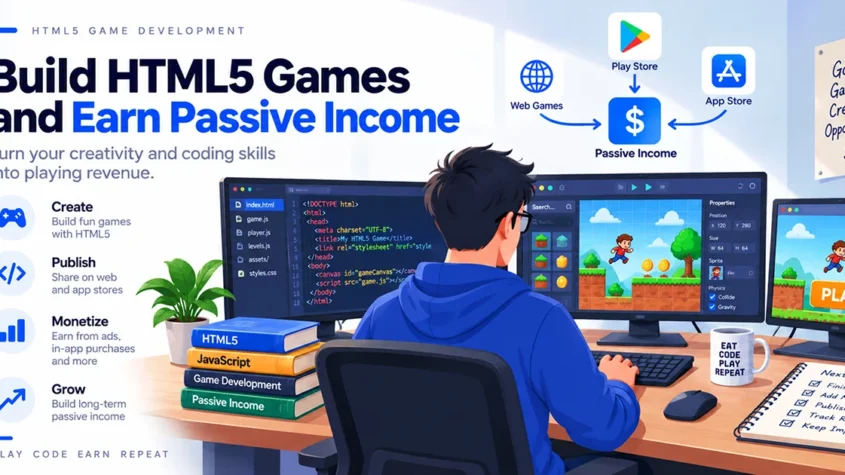
Most web developers already have more of the groundwork for game development than they realize. If you’re comfortable with HTML, CSS, and JavaScript, the leap into building a real, playable browser game is smaller than it looks from the outside — and it’s worth understanding why, especially with browser gaming having grown into a genuinely large market, valued at over six billion dollars in 2026 according to industry estimates.
Why Browser Games Are a Natural Next Step?
HTML5 game development uses the same core technologies behind every website — JavaScript for logic, and either the Canvas API or WebGL for rendering — to build a game that runs directly inside a browser tab, with no download and no app store approval process standing between you and players. For a web developer, that means the learning curve is about adopting a new way of structuring a program, not learning an entirely new language from scratch.
The biggest conceptual shift is the game loop — a function that runs continuously many times per second, handling player input, updating the game’s state, and rendering the result to the screen. Once that clicks, most of what follows starts to feel familiar: writing JavaScript functions, managing state, and responding to events, just inside a continuously running loop instead of a single page interaction.
Choosing a Game Engine Without Overcomplicating It
For a first project, Phaser is the engine most JavaScript developers should start with. It’s free, open source, and handles the more complex rendering and physics work internally, letting a developer focus on actual game logic rather than low-level graphics programming. For anyone wanting to build in 3D specifically, Babylon.js and Three.js are the two names that come up consistently, both rendering real-time 3D directly in the browser through WebGL.
The mistake worth avoiding early on is reaching for 3D or a more complex engine before building a simple 2D game first. A basic 2D project teaches the full pipeline — building, testing, and publishing — without the added complexity of 3D physics and asset pipelines competing for attention at the same time.
The Part Most Developers Don’t Expect: Real Monetization Paths
This is where game development genuinely differs from most side projects a web developer might build. Finished HTML5 games can be published for free to portals like CrazyGames or Poki, with developers earning a share of the resulting ad revenue — commonly in the range of 50% to 80% depending on the specific platform. Alternatively, a finished game can be licensed outright for a flat fee, with non-exclusive deals typically running a few hundred dollars and exclusive licenses reaching into the thousands for a well-built, well-tested game.
None of this is guaranteed income, and most individual games earn modestly rather than becoming a primary income source. But it’s a real, repeatable path available to anyone with the JavaScript skills already common among web developers — not a separate career requiring years of specialized training to access.
Getting Started Without Overthinking It
The most practical starting point is picking one simple mechanic — a character that jumps, a ball that bounces, a basic matching puzzle — and building just that, end to end, before adding complexity. A simple, complete game teaches the full development and publishing pipeline faster than an ambitious, unfinished one ever will.
For web developers specifically, this is less about learning something entirely new and more about applying existing skills in a different structure. The JavaScript, the logical thinking, and the comfort with building interactive experiences are already there — game development mostly asks you to point those same skills in a new direction.





India’s Hidden Obesity Crisis: Why “Looking Healthy” Doesn’t Actually Mean You Are
Here’s an uncomfortable fact that most standard health checkups don’t catch: y…

How to Document a Business Process in 90 Minutes (Before You Automate Anything)
You can reduce your headache by documenting a business process. It is simple to …