

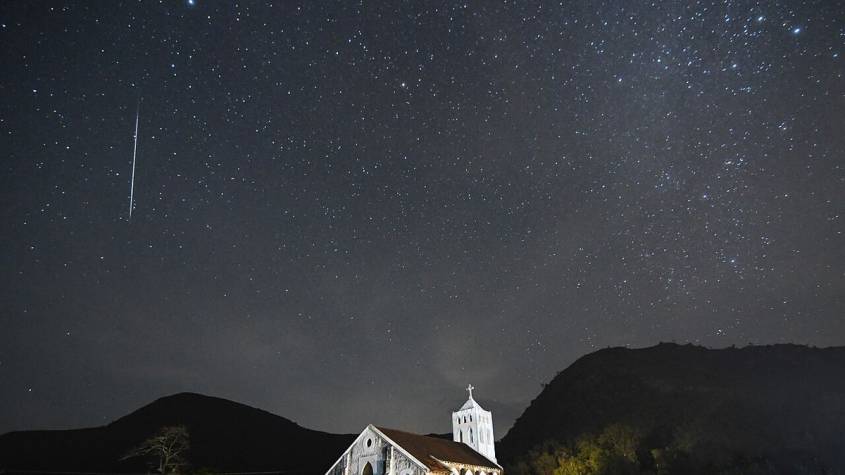
The Geminid meteor shower 2026 is the best meteor shower of the year, and this December the Moon is on our side. For observers in India, the two nights to plan for are Sunday 13 December into Monday 14 December and Monday 14 December into Tuesday 15 December 2026. A thin crescent Moon sets by mid-evening, leaving dark skies for the hours when the Geminids are at their best.
Unlike most showers, the Geminids get going before midnight, so you do not have to stay up until dawn. Here is when and how to watch from India.
Geminids 2026 at a glance
- Active period: 4 to 20 December 2026, according to the International Meteor Organization (IMO) calendar.
- IMO predicted peak: 14 December at 14:00 UT, which is 7:30 PM IST on 14 December.
- American Meteor Society peak, via EarthSky: 5:44 UTC on 14 December, which is 11:14 AM IST.
- Rate: the IMO gives a zenithal hourly rate (ZHR) of about 150; EarthSky and the Royal Observatory Greenwich quote about 120 meteors an hour under ideal skies.
- Moon: new moon on 9 December; on the peak night the IMO describes a waxing crescent about 15 percent lit.
- Radiant: near the bright star Castor in Gemini, rising in the early evening and highest around 2 AM local time.
- Parent body: the asteroid 3200 Phaethon.
Why two forecasts, and which night is best from India?
The two peak times differ by about eight hours, which is normal for meteor forecasts. The IMO notes that the Geminid maximum is broad. Strong peaks in the past two decades have fallen between 21:00 UT on 13 December and 18:00 UT on 14 December. In Indian time, that window runs from about 2:30 AM to 11:30 PM IST on 14 December.
Both forecast peaks fall in Indian daytime or early evening, so neither night is a clear winner:
- Night of 13-14 December: you watch in the hours leading up to the American Meteor Society peak, and the early part of the IMO window.
- Night of 14-15 December: you watch soon after the IMO peak at 7:30 PM IST, while rates should still be high.
If you can manage only one night, pick the one with the clearest weather forecast. If you can manage both, do both.
Best time to watch from Indian cities
The Geminid radiant rises around sunset to early evening from India, but meteor numbers climb as it gets higher. The most productive hours are from about 10 PM to 4 AM, with the radiant highest at around 2 AM.
The young Moon will not be a big problem. By our calculation, it sets at about 9:10 PM in Delhi on 13 December and about 10 PM on 14 December. Further south it sets about half an hour later; in Mumbai and Bengaluru, around 9:30 to 9:45 PM on the 13th and 10:20 to 10:30 PM on the 14th. Check a sky app for your exact location. After moonset, the sky stays dark until dawn twilight.
Which direction should you face?
Geminids seem to stream from Gemini, but they appear all over the sky. In the evening, Gemini is in the east-northeast. By about 2 AM it is high in the sky. Lie back and look at a broad patch of sky about halfway up, rather than staring straight at the radiant. Meteors farther from the radiant have longer trails, which are easier to notice.
How many will you actually see? The ZHR of 120 to 150 assumes a perfectly dark sky with the radiant directly overhead. EarthSky says a dark sky near the peak should still give at least 50 an hour. From a city with streetlights, you may see only a handful.
What makes the Geminids different
Most meteor showers come from comets, which leave dust along their orbits. The Geminids come from 3200 Phaethon, which astronomers class as an asteroid, although it behaves partly like a comet. That makes it one of the very few major showers linked to a rocky parent body.
The IMO lists the Geminids' entry speed at about 35 km per second, which is medium-slow. That is half the speed of the Leonids, so Geminids often look like slower, longer streaks, and many are bright. The IMO also notes that they rarely leave lasting trains, and that the shower is known for fireballs.
If you followed our guide to the Leonid meteor shower 2026 in November, expect a far busier sky this time. The Leonids top out at about 15 an hour; the Geminids can manage ten times that.
Viewing checklist
- Get away from lights. Light pollution matters more than anything else. A rooftop helps a little; a village, a farm or a hill station helps a lot.
- Check the weather. In December, north India often has fog, haze and smog, so watch the forecast closely. Clear desert and mountain skies tend to be better bets.
- Wrap up warmly. December nights are cold across much of north and central India, and much colder in the hills.
- Let your eyes adjust for 20 to 30 minutes. Keep your phone screen dim or use a red-light mode.
- Use your eyes. You do not need a telescope or binoculars.
- Stay safe. Go in a group, tell someone where you are going, and avoid unlit roads and cliff edges.
For photography, use a camera on a tripod with a wide-angle lens, manual focus on a bright star, and repeated exposures of 15 to 25 seconds at a high ISO for an hour or more. Modern phone night modes can catch the brightest meteors.
Where to watch
Winter travel can line up well with the shower. The dark-moon period suits the white desert at Rann Utsav in Kutch, whose next full moon falls on 22 to 24 December, well after the Geminid peak. Our winter travel guide for India covers desert and mountain destinations where skies tend to be darker. For more space news from this year, read our explainer on 2026's biggest science and space discoveries.
Frequently asked questions
When is the Geminid meteor shower 2026 peak in India?
The IMO predicts the peak at 7:30 PM IST on 14 December; the American Meteor Society says 11:14 AM IST on 14 December. Watch on the nights of 13-14 and 14-15 December.
Will the Moon spoil the Geminids in 2026?
No. A thin crescent sets by about 9 to 10:30 PM across India, leaving the best hours dark.
What time is best?
Roughly 10 PM to 4 AM, with the radiant highest around 2 AM.
Can I see the Geminids from a city?
Only the brightest. Head away from city lights if you can.
Sources: International Meteor Organization 2026 meteor shower calendar; EarthSky Geminid guide (American Meteor Society peak prediction); Royal Observatory Greenwich. Moonset times are approximate and were calculated by us for Delhi, Mumbai and Bengaluru. Rates assume ideal conditions; local weather and light pollution decide what you actually see.
Featured image: Drashokk / Wikimedia Commons, CC BY-SA 4.0 (resized). A Geminid meteor over the church at Sunkarametta near Araku, Andhra Pradesh (2018); not a 2026 photo.
International Gita Mahotsav 2026: Dates, Events and Kurukshetra Guide
The International Gita Mahotsav 2026 will be held in Kurukshetra, Haryana, from 5 to 25 De…




Why 71% of Indian Homebuyers Are Now Choosing ₹1 Crore+ Homes in 2026
There’s a number floating around in property circles right now that genuinely stops people …