

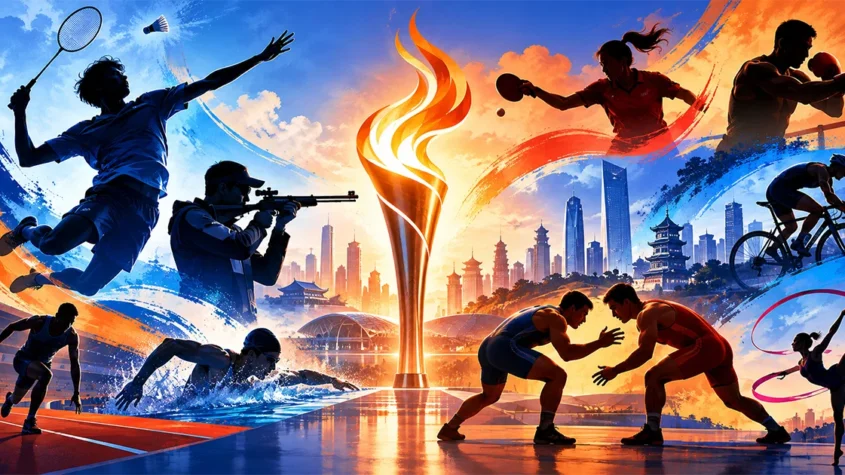
Cricket, by default, usually is the major highlight of Indian sports news, but the real picture of India’s quest for medals at the 2026 Asian Games to be hosted by Aichi-Nagoya is way more intriguing than the focus on cricket alone. With a large Indian team of 503 athletes, 269 males and 234 females, competing in a range of sports disciplines between September 19 and October 4, India’s gold medal chances this time around lie across practically every single category that the Games have on offer.
The scale of India’s contingent
India’s 503-athlete contingent for Aichi-Nagoya is smaller than the 655- athlete group India had in Hangzhou 2023 Asian Games, when India competed in 41 disciplines across 36 sports, and delivered a record-breaking medal count a first-ever 100-medal mark crossing in Indian Asian Games history- and ended with fourth place overall. Even with fewer athletes, the team covers many sports: athletics, shooting, badminton, hockey, wrestling, boxing, weightlifting, archery, kabaddi, table tennis, cricket (and more). India’s competitive journey has actually started before the official opening of the Games, where a sports event of teqball had taken place on 17th September, followed by the Women’s cricket team taking on Japan opening match on 18th September.
The stars carrying India’s medal hopes
A few individual names are drawing particular attention heading into the Games. Two-time Olympic medallist PV Sindhu headlines India’s badminton challenge, with the individual competition beginning September 20 at the Ichinomiya City Municipal Gymnasium, following the team events. She’s joined on the badminton roster by Lakshya Sen, HS Prannoy, and Satwiksairaj Rankireddy, giving India a genuinely strong squad across both singles and doubles categories.
Manu Bhaker, double Olympic medallist, will be one of India’s top performers at the shooting range. For many years, shooting has been India’s most successful medal-winning event in the Asian Games, and people look forward to another good result this year too. In weightlifting, Mirabai Chanu, an Olympic medallist, is heading the India team which includes five weightlifters. The sport of Wrestling is another traditional podium event for India, and Aman Sehrawat with a bronze from the Paris 2024 will be among the candidates.
The defending champions with targets on their backs
India enters several team events this year specifically as defending champions, which changes the pressure calculus considerably compared to simply chasing a new medal. The men’s and women’s hockey teams both arrive as defending Asian Games champions — the men’s side opens against Indonesia, while the women’s team faces Uzbekistan. India is also defending both the men’s and women’s kabaddi gold medals, in a tournament running September 21-26, marking kabaddi’s ninth consecutive appearance at the Games since 1990, a discipline India has dominated continentally for decades.
And as covered in more detail in our cricket-specific coverage, both the men’s and women’s cricket teams are also defending gold medals from the previous Games, with the women’s team opening their quarterfinal campaign against Japan on September 18 and the men’s side, led by Shreyas Iyer, beginning their own campaign shortly after.
Where the biggest medal count is likely to come from?
Athletics is where India traditionally pulls in its largest single share of medals at the Asian Games, and this year is expected to follow that pattern. The athletics program runs September 23-29 across two Nagoya venues, spanning track and field, road running, and racewalking, with 50 total medal events on offer — the single biggest medal pool of any discipline at these Games, which is exactly why athletics performance tends to make or break India’s overall final tally more than any other sport.
Why this matters beyond the medal count?
It’s worth stepping back from the individual results to note what a campaign this broad actually represents. India’s growing strength across shooting, badminton, wrestling, weightlifting, and athletics — alongside its traditional dominance in kabaddi and recent success in hockey and cricket — reflects a genuinely more diversified sporting base than India had a decade or two ago, when the country’s Asian Games hopes rested far more narrowly on a handful of disciplines. The 2023 Hangzhou result, where India finished best-performing nation in archery, kabaddi, cricket, and hockey, and second-best in athletics, shooting, and squash, set a genuinely high bar. Whether Aichi-Nagoya builds on that or represents a step back will likely depend less on any single star performer and more on how consistently India’s athletes perform across this full spread of sports over the two-and-a-half-week competition window.
Schedules, squads, and results are subject to change. Check the Indian Olympic Association and official Asian Games channels for the latest confirmed information.




India’s 80th Independence Day: The Real Story Behind August 15, and Why the Date Itself Has a Strange History
This August, India marked its 80th year of independence — a genuine milestone, and one tha…

How to Document a Business Process in 90 Minutes (Before You Automate Anything)
You can reduce your headache by documenting a business process. It is simple to …