


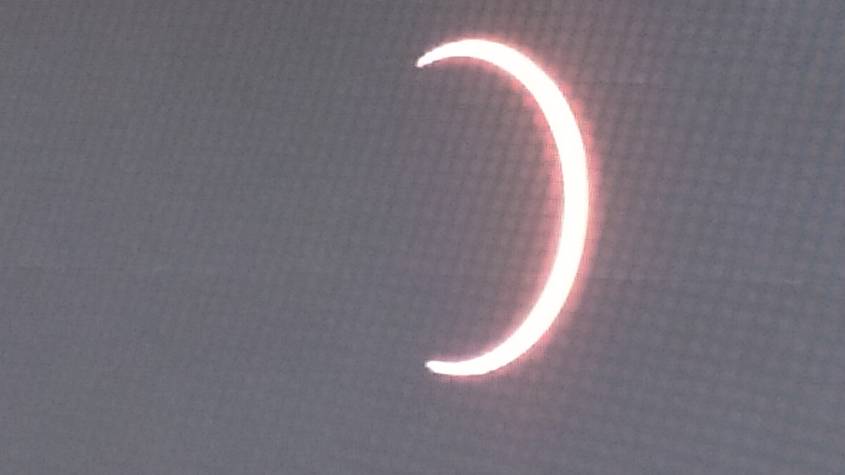
There are two solar eclipses in 2027, and only one of them reaches India. The solar eclipse 2027 that matters here is the total eclipse on Monday, 2 August 2027. Its path of totality crosses North Africa and Arabia, while India gets a partial eclipse in the late afternoon, roughly between 3:34 PM and 5:53 PM IST, depending on where you are, according to timeanddate.com.
The other one, an annular eclipse on 6 February 2027, will not be visible from India at all.
How many solar eclipses are there in 2027?
Two. An annular solar eclipse on 6 February 2027 and a total solar eclipse on 2 August 2027. India sees only the second one, and only as a partial eclipse.
| Eclipse | Date | Central path | Visible from India? |
|---|---|---|---|
| Annular solar eclipse | Saturday, 6 February 2027 | Chile, Argentina, the Atlantic and West Africa | No |
| Total solar eclipse | Monday, 2 August 2027 | Morocco, Spain, Algeria, Libya, Egypt, Saudi Arabia, Yemen, Somalia | Yes, partial only |
Sources: NASA’s solar eclipse table for 2021-2030 (eclipse predictions by Fred Espenak, NASA’s GSFC) and timeanddate.com.
Total solar eclipse 2027 on 2 August: why it is a big one
It is the longest total eclipse in NASA’s table for the decade 2021-2030. NASA lists a central duration of 6 minutes 23 seconds at greatest eclipse, with a magnitude of 1.079. For comparison, the famous North American eclipse of April 2024 managed 4 minutes 28 seconds at its best, by the same NASA table.
Timeanddate estimates that about 4.62 billion people live where some part of the eclipse can be seen, and about 88.9 million inside the path of totality. Worldwide, the partial phase begins at 07:30 UTC (1:00 PM IST) and ends at 12:43 UTC (6:13 PM IST), with maximum eclipse at 10:06 UTC, or 3:36 PM IST.
Indians will not see the corona or the day turning to night; that needs a flight to Egypt, Saudi Arabia or southern Spain. India gets a bite out of the afternoon Sun.
Solar eclipse 2027 time in India: city-wise timings
Across India, the partial eclipse runs from about 3:34 PM to 5:53 PM IST on 2 August 2027. The further south and west you are, the more of the Sun the Moon covers.
| City | Begins (IST) | Maximum (IST) | Ends (IST) | Magnitude at maximum |
|---|---|---|---|---|
| New Delhi | 3:53 PM | 4:29 PM | 5:02 PM | 0.169 |
| Mumbai | 3:47 PM | 4:41 PM | 5:31 PM | 0.432 |
| Kolkata | 4:14 PM | 4:43 PM | 5:12 PM | 0.137 |
| Chennai | 4:02 PM | 4:54 PM | 5:41 PM | 0.452 |
| Bengaluru | 3:58 PM | 4:53 PM | 5:43 PM | 0.494 |
Magnitude is the fraction of the Sun’s diameter covered by the Moon. Bengaluru does the best of these five, with nearly half the Sun’s width covered; in Kolkata and Delhi it is a small nibble that you would miss without a filter. For any other town, check the timeanddate city page; timings are accurate to within a few seconds, the site says.
Will the solar eclipse 2027 be visible in India?
Yes, as a partial solar eclipse on the afternoon of 2 August 2027. The total phase will not be visible anywhere in India.
The real problem: the monsoon
Early August is peak monsoon, and the weather record is not kind. Timeanddate’s historical data says 2 August has been cloudy 88% of the time in New Delhi since 2000, 92% in Mumbai and Bengaluru, 94% in Kolkata and 85% in Chennai.
So plan for the solar eclipse 2027, but keep expectations low. Watch the forecast in the last few days and treat a clear window as a bonus. A gap in the clouds for even ten minutes around maximum is enough to see the bite. Some keen skywatchers may simply fly to the path of totality instead.
How to watch the solar eclipse safely
Never look at a partial eclipse with the naked eye. During a partial or annular eclipse, NASA’s eclipse safety guidance says you must use proper solar viewing glasses or a handheld solar viewer at all times, because there is no moment when the Sun’s bright face is fully covered.
- Eclipse glasses are not sunglasses. NASA says safe viewers are thousands of times darker and should meet the ISO 12312-2 standard.
- Check them first. Throw away any pair that is scratched or torn, and supervise children.
- No optics with eclipse glasses. Looking through a camera, binoculars or telescope while wearing eclipse glasses can burn through the filter and injure your eyes. Optics need their own solar filter fitted on the front.
- The cheap, safe option: a pinhole projector. Punch a small hole in a card, stand with the Sun behind you, and look at the projected crescent on paper or on the ground. A kitchen colander works too.
Families who observe the traditional sutak period should take its timings from their local panchang.
Lunar eclipses in 2027 and the next solar eclipse after that
Beyond the solar eclipse 2027 calendar, the year also has lunar eclipses, but none is dramatic from India. The penumbral lunar eclipse of 20-21 February 2027 is listed as visible from Indian cities, running from 2:42 AM to 6:43 AM IST on 21 February (21:12 to 01:13 UTC), with maximum at about 4:42 AM IST, according to timeanddate.com. Being penumbral, it only dims the Moon slightly.
After August 2027, the next solar eclipse visible from southern India is the total eclipse of 22 July 2028, whose totality falls over Australia and New Zealand. Timeanddate lists it as partial from Chennai and Bengaluru, but not from Delhi, Mumbai or Kolkata.
Planning ahead
2 August 2027 is a working Monday, and the eclipse falls in office hours across most of India, so a terrace or office window is the realistic plan for most of us. Our 2027 holiday and long-weekend list can help if you are thinking of a trip to the path of totality instead.
Before then, the sky has plenty to offer. The Geminid meteor shower peaks on 13-15 December 2026, and if you missed November’s show, our Leonids guide explains what the next return of comet Tempel-Tuttle could bring. For a wider look at the year in space, read our roundup of 2026’s biggest science and space discoveries.
Frequently asked questions
When is the next solar eclipse in India?
The next solar eclipse visible from India is the partial eclipse on Monday, 2 August 2027, in the late afternoon.
Is the February 2027 solar eclipse visible in India?
No. The annular eclipse of 6 February 2027 is seen from South America, the Atlantic and Africa only.
How long is totality on 2 August 2027?
Up to 6 minutes 23 seconds at greatest eclipse, according to NASA. India sees only a partial phase.
Sources: NASA GSFC solar eclipse table 2021-2030 (eclipse predictions by Fred Espenak, NASA’s GSFC); NASA eclipse safety guidance; timeanddate.com global and city eclipse pages. City times are for the five cities shown; your local times will differ slightly.
Featured image: Minusaji / Wikimedia Commons, CC BY-SA 4.0 (resized). Partial phase of the 26 December 2019 solar eclipse at Kuravilangad, Kerala; not a 2027 photo.
