

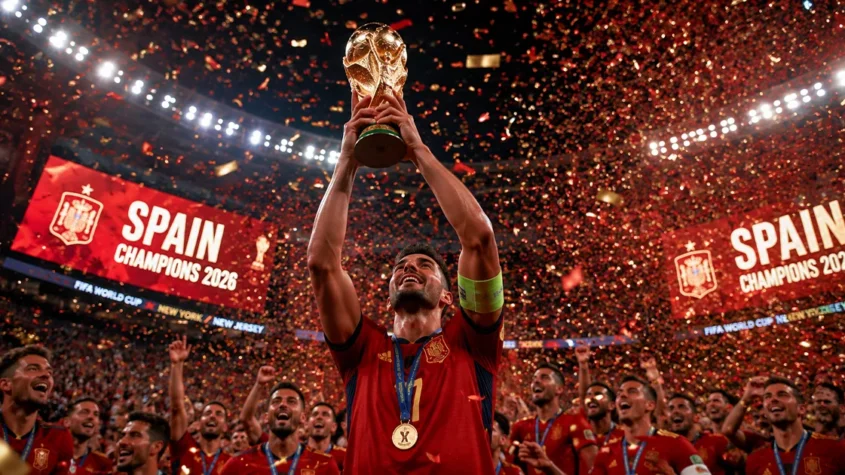
It’s been a full month since Spain took down Argentina 1-0 in that wild final at the New York/New Jersey stadium. You’d think the noise around the 2026 World Cup would’ve died down by now, but FIFA isn’t letting that happen.
Just weeks after the trophy was lifted, Gianni Infantino threw another curveball: discussions are officially happening to bump the tournament up to 64 teams.
Yeah, you read that right. We just survived the jump to 48, and they’re already itching for more.
Spain’s Revenge & The Golden Boot Madness
That 1-0 final wasn’t just another win for Spain—it was their first title since 2010. Even bigger, they snapped Argentina’s insane 13-game World Cup streak, stopping Messi’s squad from going back-to-back like Brazil did decades ago.
And man, the individual stats this year were completely out of hand. Messi and Mbappé tied for top scorer with eight goals apiece, while Haaland trailed right behind them with seven. It’s actually the first time in history we’ve seen three different players pass the seven-goal mark in a single tournament. Over on the English side, Kane and Bellingham made their own piece of history, becoming the first duo from England to drop six goals each.
The Numbers Were Pure Chaos
Before kickoff back in June, everyone was complaining that adding 16 extra teams would ruin the quality of football. Safe to say, those takes aged horribly. The fans showed up in ways nobody expected, completely blowing the legendary 1994 US attendance out of the water.
-
Over 6.8 million fans packed into stadiums across the US, Canada, and Mexico. That’s double 1994’s record.
-
Stadiums were sitting at a crazy 99.7% capacity, averaging roughly 65,490 people per match.
-
We got 104 total matches—40 more than previous years—which pumped out a record-breaking 308 goals.
-
Even the economic numbers were stupidly high, pulling in an estimated $40.9 billion across host cities.
The Underdogs Stole the Show
Turns out, the 48-team layout actually worked. Small nations didn’t just come to pad the schedule; they came to play.
Take Cape Verde, for instance. One of four debutants this year, they actually made it out of the group stage and gave Argentina everything they could handle. Then you had tiny Curaçao—literally the smallest country to ever qualify—turning into everyone’s favorite side story just by showing up and fighting.
Sure, the format had its flaws. Having 12 groups of four meant some teams advanced after drawing all three games, and forcing finalists to play eight games instead of seven left a lot of European club managers fuming about player fatigue. But as a viewer? It was non-stop entertainment.
So, What’s the Deal with 64 Teams?
Look, Infantino bringing up 64 teams isn’t an official rule change yet—it’s mostly internal talk for now. But we all know how FIFA operates.
More teams mean more broadcast money, bigger sponsor checks, and endless matches to sell. The real question is whether football can actually survive that kind of expansion without grinding the players into dust or making the group stages feel meaningless.
2026 proved that bigger can work, but if FIFA pushes it to 64, we might finally hit the breaking point.