

If your favorite YouTuber suddenly seems to be getting more views than usual, don’t immediately assume they’ve cracked the algorithm.
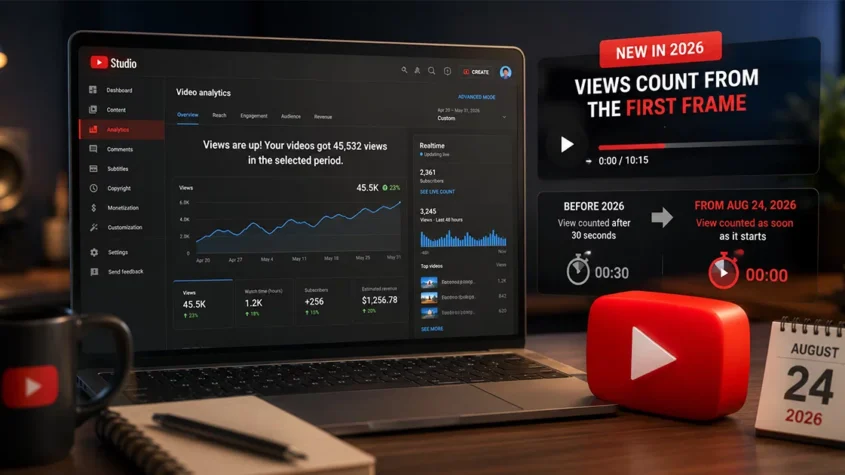
YouTube changed the way it counts public views on August 24, 2026. From that date, a view can be added as soon as a video begins playing — right from the first frame. The same basic rule now applies to long-form videos, Shorts, podcasts and live content.
For an ordinary viewer, this probably won’t change much. For creators and brands, it’s a bigger deal.
Views sit underneath almost every video on YouTube. They’re used in creator media kits, sponsorship pitches, campaign reports and, fairly or not, as a quick way of deciding whether a video performed well. When the definition behind that number changes, comparisons get messy.
So here’s what actually changed — and what didn’t.
What Changed on August 24?
The new rule is fairly simple. If a YouTube video starts playing, it can generate a public view from its first frame.
That includes a normal click or tap to watch, but it can also include eligible autoplay. YouTube gives the example of a long-form video beginning to play automatically when someone hovers over it on the Home page.
Just scrolling past a static thumbnail doesn’t count. That’s still an impression.
You may have heard that YouTube previously required 30 seconds of watch time before a normal video counted as a view. That number has been repeated online for years, but YouTube never published it as one universal rule covering every standard video.
What YouTube does confirm is that it previously had different view-counting systems for different formats. The August update is meant to bring those formats under one public definition.
Shorts Had Already Made the Switch
YouTube didn’t come up with first-frame counting overnight.
Shorts moved in this direction on March 31, 2025. From that point, a Shorts view started counting whenever a Short began playing or replaying, without a minimum watch-time requirement.
YouTube kept the older Shorts measurement too, renaming it engaged views.
Now a similar idea has reached the rest of the platform. Whether you’re uploading a Short, a 15-minute tutorial, a podcast or going live, the public counter follows the same basic first-frame approach.
That’s useful for consistency. It also means creators need to be more careful about what they call a “view.”
Public Views and Engaged Views Are Not the Same Thing
This is the part creators really need to understand.
Imagine someone comes across your video on YouTube Home. It starts playing automatically, but they move on almost immediately.
That playback can now contribute to the public view count.
Now imagine someone sees your thumbnail, clicks it and sits through a meaningful portion of the video. Obviously, those two viewers didn’t give your content the same level of attention.
That’s why engaged views matter.
YouTube describes an engaged view as someone watching beyond the initial first frame or actively clicking or tapping to watch. There isn’t one publicly stated number of seconds that defines an engaged view across every YouTube format.
So rather than treating the two numbers as competitors, think about what they’re telling you.
Public views show exposure. Engaged views tell you more about actual viewing behavior.
Creators can dig into engaged-view data inside YouTube Analytics, including Advanced Mode.
Will Your YouTube Views Go Up?
Quite possibly.
YouTube itself has acknowledged that public view counts are likely to accumulate faster under the new system.
That doesn’t mean everyone wakes up with twice as many views on August 25. The effect will vary from channel to channel.
A creator who gets a lot of Home-page exposure and autoplay may notice a bigger change than someone whose viewers usually search for a video and deliberately click it.
This also makes before-and-after comparisons awkward.
Suppose your videos averaged 40,000 views in July and similar uploads average 55,000 in September. That’s encouraging, but you can’t automatically call it 37.5% audience growth. Part of the difference could simply come from the new counting method.
If you report channel performance monthly, August 24 should be marked in your data. Otherwise, future growth charts could tell a slightly misleading story.
What About Monetization?
This is probably the first question many creators will ask: if public views are easier to register, does that mean more money?
Not automatically.
YouTube says the new public-view methodology doesn’t directly change how creator earnings are calculated. Monetization continues to rely on engagement-based measurements such as Engaged Shorts Views and Engaged Watch Hours.
In other words, YouTube isn’t treating a fleeting first-frame exposure as equal to someone who actually stays and watches when it comes to paying creators.
The same distinction matters for the YouTube Partner Program.
For the main ads and YouTube Premium revenue-sharing level, creators currently need:
- 1,000 subscribers and 4,000 qualified public watch hours during the previous 12 months, or
- 1,000 subscribers and 10 million qualified public Shorts views during the previous 90 days.
The public number underneath your video might move faster after August 24. Your monetization progress won’t necessarily move with it.
Did YouTube Change the Algorithm Too?
No — at least not because of this update.
YouTube says its recommendation system hasn’t changed as part of the new public-view definition.
That distinction matters because it’s easy to imagine creators chasing first-frame views and assuming the old rules of channel growth no longer apply.
They still do.
Your thumbnail and title need to make someone interested enough to watch. Your opening needs to give them a reason not to leave. And the video itself still has to hold their attention.
Metrics such as click-through rate, average view duration and audience retention therefore remain far more useful than staring at the public counter alone.
Getting counted is easier. Keeping someone’s attention isn’t.
What Happens to Older Videos?
YouTube isn’t going back through your entire channel and recalculating every historical view.
If a video had one million views before August 24, its past views aren’t suddenly rebuilt using the new definition.
But older videos can collect new views under the new system when they’re played after August 24.
This is especially relevant for channels with evergreen tutorials, music, educational videos or other content that continues getting traffic for years.
Brands Should Stop Looking at Views Alone
For marketers, this update makes one habit increasingly difficult to defend: judging a creator almost entirely by the public view count.
Say two creators both show 500,000 views.
One has an audience that watches for several minutes, leaves comments and clicks sponsored links. The other’s videos receive huge exposure but lose most viewers almost immediately.
Those aren’t equally valuable audiences just because the headline number matches.
When evaluating a YouTube sponsorship, brands should look beyond views and ask for metrics such as:
- engaged views;
- watch time;
- average view duration;
- audience retention;
- relevant audience demographics;
- clicks or conversions, where available.
It may also be time to tighten the wording in sponsorship agreements.
If a contract promises payment after a video reaches “100,000 views,” both sides should know exactly which view metric they’re talking about. Public views and deeper engagement can now paint noticeably different pictures.
Does This Make YouTube More Like TikTok and Instagram?
Short-form platforms have already pushed the industry toward playback-based headline metrics, and YouTube itself adopted start-or-replay counting for Shorts in 2025.
Having one public definition across YouTube makes its formats easier to compare internally and brings its headline metric somewhat closer to how short-form video is measured elsewhere.
But a million views on YouTube, TikTok and Instagram still shouldn’t automatically be treated as equivalent.
People discover and consume content differently on each platform. Autoplay behavior differs. So do feeds, recommendations and engagement measurements.
Cross-platform reports still need context.
So, Is a YouTube View Less Valuable Now?
Not exactly. It just tells you something slightly different.
The public number is now a broader picture of how often your content started playing. That’s useful information, particularly if you want to understand reach.
But if you’re trying to figure out whether people actually liked the video enough to stay, you’ll need to go deeper into Analytics.
For creators, that’s probably the healthiest way to look at the update anyway.
A big number underneath a video feels good. But 100,000 people seeing the beginning of something and 100,000 people choosing to keep watching it were never really the same achievement.
Now YouTube’s metrics make that difference a little harder to ignore.
Final Thoughts
The biggest change here isn’t that YouTube suddenly made views meaningless. It didn’t.
What changed is what that big number underneath a video represents.
From August 24 onward, public views give creators a broader picture of exposure. If you want to know whether that exposure turned into genuine attention, look at engaged views, watch time and retention. And if your views suddenly jump?
Enjoy the bigger number. Just check Analytics before declaring that you’ve gone viral.
Frequently Asked Questions
When did YouTube’s new view-counting system start?
The change took effect globally on August 24, 2026, bringing YouTube’s major video formats under a standardized public-view definition.
Does one second now count as a YouTube view?
A public view can register from the first frame of eligible playback, so it doesn’t necessarily require a full second of viewing.
Does autoplay count as a view?
Eligible autoplay can count once the video begins playing. Simply seeing a static thumbnail still counts as an impression rather than a view.
What is an engaged view on YouTube?
An engaged view reflects stronger viewing behavior beyond initial first-frame exposure or an active click or tap to watch. Creators can examine engagement data through YouTube Analytics.
Will creators earn more because public views increase?
Not automatically. YouTube says creator earnings continue to rely on engagement-based measurements rather than simply the new public view counter.
Did YouTube change its recommendation algorithm?
YouTube says no. The August 24 update changes public view counting, not the recommendation algorithm.





Pasqal Goes Public on Nasdaq After $2 Billion Quantum Computing Deal
Quantum computing companies are still trying to prove how big the commercial market for th…

How to Document a Business Process in 90 Minutes (Before You Automate Anything)
You can reduce your headache by documenting a business process. It is simple to …